Guaranteed Minimum Pension (GMP) explained
If you were in a final salary scheme between 1978 and 1997, part of your pension may be a Guaranteed Minimum Pension. Here's what GMP is, how it increases, what equalisation and conversion mean, and why it matters if you are looking into a transfer.
By Phillip Handley, Chartered Financial Adviser (LIBF), Adv DipFA
What is GMP in pensions?
A Guaranteed Minimum Pension (GMP) is the minimum pension a contracted-out final salary scheme must pay for service between 6 April 1978 and 5 April 1997. It broadly replaces the SERPS pension members gave up, is payable from 65 for men and 60 for women, and follows special increase rules.
What is a Guaranteed Minimum Pension?
A Guaranteed Minimum Pension (GMP) is the minimum pension a defined benefit scheme must pay for the time a member was "contracted out" of the State Earnings Related Pension Scheme (SERPS) between 6 April 1978 and 5 April 1997. It was designed to be broadly the same as the SERPS pension the member gave up by contracting out.
If your pension statement mentions GMP, it usually means that part of your final salary pension relates to that contracted-out period, and that special rules apply to that part.
Contracting out in brief
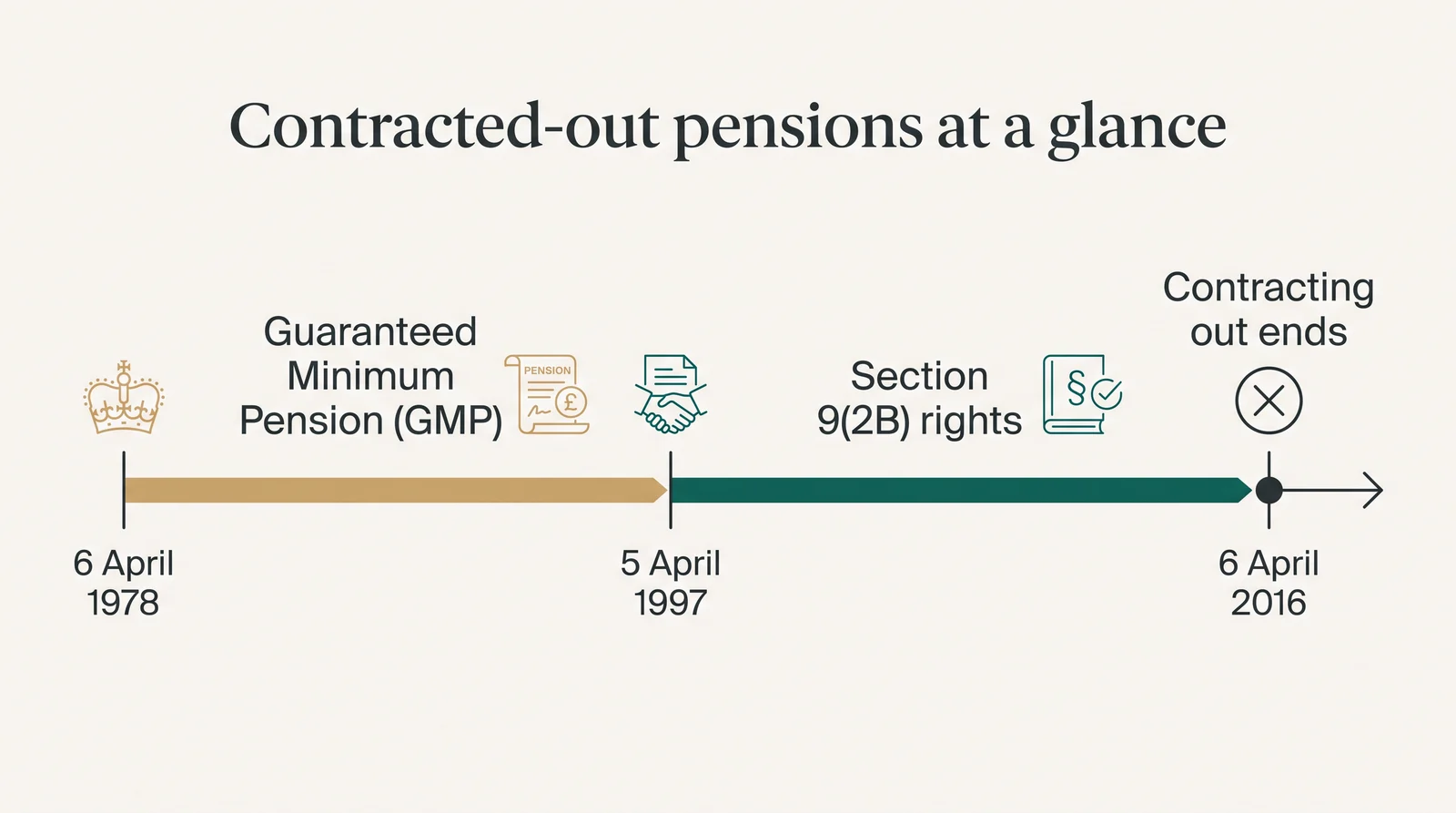
From April 1978, the State paid an earnings-related pension, SERPS, on top of the basic State Pension. Employers with a final salary scheme could choose to "contract out" of SERPS. When that happened:
- the employer and employee paid lower National Insurance contributions
- the employee didn't build up SERPS for that time
- in return, the scheme had to promise a pension at least equal to the GMP
In effect, part of the State Pension was provided privately, through the workplace scheme. The scheme had to meet that promise whether or not its investments performed well.
GMP stopped building up on 5 April 1997. From 6 April 1997, contracted-out schemes had to meet a different test, and the pension built up after that date is known as section 9(2B) rights. Contracting out ended altogether on 6 April 2016, when the new State Pension was introduced.
GMP can also appear in some section 32 buy-out plans, individual policies that took over benefits from a contracted-out final salary scheme.
Does GMP affect my State Pension?
Because you paid lower National Insurance while contracted out, your State Pension may be lower than it would otherwise have been. Your GMP is meant to make up for this. The government's page on contracted-out pension schemes and the State Pension explains how the two fit together, and you can check your State Pension forecast online.
When GMP is paid
GMP is payable from GMP age, which is 65 for men and 60 for women. This difference between men and women is the root of GMP equalisation, explained below.
In most schemes, your GMP is part of your total scheme pension, not an extra amount on top. For example, if your scheme pension is £10,000 a year and your statement shows a GMP of £3,000 a year, the GMP is usually £3,000 of the £10,000. The scheme must make sure your pension is never less than the GMP.
How GMP increases
Before it is paid: revaluation
If you left the scheme before GMP age, your GMP is increased each year until it is paid. Schemes used one of these methods:
- In line with national average earnings, using yearly orders made by the government.
- At a fixed rate, set according to when you left contracted-out employment.
- Limited revaluation, the lower of earnings growth and 5% a year, which was available to some schemes for members who left before April 1997.
The fixed rates have been:
| When you left contracted-out employment | Fixed revaluation rate a year |
|---|---|
| Before 6 April 1988 | 8.5% |
| 6 April 1988 to 5 April 1993 | 7.5% |
| 6 April 1993 to 5 April 1997 | 7% |
| 6 April 1997 to 5 April 2002 | 6.25% |
| 6 April 2002 to 5 April 2007 | 4.5% |
| 6 April 2007 to 5 April 2012 | 4% |
| 6 April 2012 to 5 April 2017 | 4.75% |
| From 6 April 2017 | 3.5% |
The rate that applies is fixed when you leave and stays the same until your GMP is paid. Some of these rates are higher than inflation has been for much of the time since, which is one reason GMP can be a valuable part of a pension. Your scheme can tell you which method and rate applies to you.
Once it is being paid: increases in payment
GMP is split into two parts, depending on when it was built up:
- Pre-1988 GMP (built up from 6 April 1978 to 5 April 1988). The law doesn't require the scheme to increase this part once it is in payment.
- Post-1988 GMP (built up from 6 April 1988 to 5 April 1997). The scheme must increase this part each year in line with inflation, up to 3% a year.
For people who reached State Pension age before 6 April 2016, the State generally added the missing inflation increases through the additional State Pension. For people who reached State Pension age on or after 6 April 2016, under the new State Pension, the State no longer pays this top-up in the same way, so the increases on GMP depend more on the scheme's own rules. Separate arrangements apply to some public-sector schemes.
Many schemes pay more than the legal minimum. Your scheme booklet, or the scheme administrator, can tell you how your GMP and the rest of your pension increase.
GMP and tax-free cash
GMP has to be paid as a pension. Depending on your scheme's rules, this can affect how much tax-free cash you can take:
- In some final salary schemes, the pension left after you take tax-free cash can't fall below your GMP. If GMP makes up a large part of your pension, this can limit the cash available.
- In a section 32 buy-out policy with a GMP guarantee, the provider must hold back enough money to provide the GMP. If the policy's investments haven't grown enough, there may be less than the usual 25% available as tax-free cash.
Illustrative example: imagine a section 32 policy worth £100,000. If the provider calculates that £90,000 is needed to secure the GMP, the tax-free cash available could be well below £25,000. This is an example only. The figures for any real policy depend on the provider's calculations and rules.
Your scheme or provider can tell you how much tax-free cash is available and whether the GMP limits it.
GMP equalisation
Why it was needed
On 17 May 1990, a European Court of Justice ruling in the Barber case meant that pension schemes had to provide equal benefits for men and women for service from that date.
GMP didn't fit easily with this. It is worked out differently for men and women: it is payable at 65 for men and 60 for women, and it builds up at different rates. So a man and a woman with the same pay and service could end up with different overall pensions because of their GMPs. For years, schemes and the pensions industry were unsure whether, and how, they had to correct this.
The Lloyds rulings
- October 2018. In a case brought by the trustee of the Lloyds Banking Group pension schemes, the High Court ruled that schemes must equalise benefits for the effect of unequal GMPs built up between 17 May 1990 and 5 April 1997. The court set out acceptable methods for doing this, including converting GMPs into ordinary scheme benefits.
- November 2020. A second ruling in the same case found that schemes must also look again at transfers out made since 17 May 1990. Where a past transfer value was too low because of unequal GMPs, the original scheme must pay a top-up to the scheme the member transferred to.
What it means for you
- Many schemes have already completed GMP equalisation, and others are still working through it.
- Any adjustment depends on your sex, your service and your scheme's figures. For many members it is small, and for some there is no change at all.
- If you are owed arrears, your scheme will explain how much and how they will be paid, subject to its rules.
- If you transferred out of a scheme after 17 May 1990 and had GMP for service between 1990 and 1997, your former scheme may owe a top-up. It is worth asking whether it has reviewed past transfers.
- If you ask for a transfer value now, ask the scheme whether it reflects GMP equalisation.
You can read more in our article on the GMP equalisation ruling.
GMP conversion
The law allows schemes to convert GMPs into ordinary scheme benefits. This is called GMP conversion. It can be used as a way of equalising benefits, and it makes schemes simpler to run, because the special GMP rules no longer apply.
The main points are:
- the converted benefits must be of at least equal actuarial value to the benefits they replace
- a pension for a surviving spouse or civil partner must still be provided
- the employer must agree, and members must be consulted and told about the change
- after conversion, your pension follows the scheme's ordinary rules on when it is paid and how it increases
Conversion can change the shape of your benefits, for example how your pension increases each year, even though the overall value is meant to stay the same. If your scheme writes to you about GMP conversion, read the information carefully and ask the scheme if anything is unclear.
Why GMP matters if you are thinking about a transfer
If your final salary pension includes GMP, it is an important part of what you would be giving up if you transferred.
- GMP is a safeguarded benefit. If your safeguarded benefits are worth more than £30,000, the law requires you to take advice from an FCA-authorised firm with the pension transfer permission before you can transfer.
- The FCA's starting assumption applies. Advisers must start by assuming that a transfer from a defined benefit pension won't be suitable for you. For most people, keeping the pension is the better option. See the FCA's guide to defined benefit pension transfers.
- You would give up the guarantee. A transfer replaces the GMP, its increases and any survivor's pension with an invested pot that can fall in value.
People sometimes ask about transferring because of GMP, for example where it limits tax-free cash, or where they want to compare a guaranteed pension with an annuity bought on the open market or with drawdown. These are reasonable questions. A regulated adviser would weigh them against everything you would give up, including the guaranteed, inflation-linked income and the benefits for your spouse or dependants.
If you take advice, you may find it useful to ask the adviser:
- how much of my pension is GMP, and how does each part increase?
- has my scheme equalised GMPs, and is equalisation reflected in my transfer value?
- has my scheme converted GMPs, or does it plan to?
- how does GMP affect the tax-free cash I could take from the scheme?
- what would my spouse or dependants lose if I transferred?
We do not give defined benefit pension transfer advice. We offer a free, no-obligation chat explaining how GMP, transfers and the advice process work. If you then want regulated advice, we can introduce you to an FCA-authorised firm that holds the pension transfer permission. Arthur Browns may receive a fee from the firm we introduce you to if you become their client.
Read our main guide to how defined benefit pension transfers work.
Frequently asked questions
What does GMP mean on my pension statement?
It shows the Guaranteed Minimum Pension part of your scheme pension, built up while you were contracted out between 1978 and 1997. It is usually part of your total pension, not an extra amount.
When is my GMP paid?
GMP is payable from age 65 for men and 60 for women. Your scheme's normal pension age may be different, and your scheme may have converted GMPs into ordinary benefits, so check with your scheme.
Has my scheme equalised GMPs?
Ask your scheme administrator. Schemes should tell members when they equalise benefits and whether any arrears or adjustments are due.
I transferred out years ago. Could I be owed money?
Possibly, if you transferred out after 17 May 1990 and had GMP built up between 1990 and 1997. Contact your former scheme and ask whether it has reviewed past transfers following the November 2020 ruling. Any top-up is normally paid to the pension you transferred to.
Can I transfer a pension that includes GMP?
If your scheme allows transfers and you have not started taking the pension, usually yes. If your safeguarded benefits are worth more than £30,000, you must take regulated advice first, and the FCA's starting assumption is that a transfer is unlikely to be suitable.
Where can I get free help?
MoneyHelper offers free, impartial guidance on pensions, and Pension Wise offers free guidance on your pension options from age 50.
Important: Arthur Browns Wealth Management Ltd (FCA 825843) does not give defined benefit pension transfer advice. The FCA starts from the position that a transfer is unlikely to be suitable for most people, and a transfer cannot usually be reversed. See Important information.
Last reviewed 23 October 2026