Guide
Can I withdraw my pension pot to my bank account


Yes. Once you reach the minimum pension age (55 now, rising to 57 on 6 April 2028), you can usually withdraw some or all of a defined contribution pension pot and have it paid into your bank account. Usually 25% is tax-free and the rest is taxed as income, so taking a large sum in one go can mean a big tax bill. Defined benefit (final salary) pensions work differently: they pay an income rather than a pot you can withdraw.
Can I transfer my pension to my bank account?
In short, yes, you can take money from a pension pot and have it paid to your bank account, but whether it is a good idea depends on your circumstances. The size of your pot, your other income and your tax position all matter. Withdrawing a lot at once could push you into a higher tax band. This guide looks at the options and what they mean.
How to access pension income
When you reach the minimum pension age (currently 55, but rising to 57 from 6 April 2028), you have several options for a defined contribution pension, including pension drawdown, an annuity or taking lump sums. Each has its own tax rules, so it is important to understand them before you decide.
The same broad rules apply to workplace and personal pensions. Some older schemes have special features, such as a protected pension age, protected tax-free cash above 25% or a guaranteed annuity rate, so check with your scheme administrator before you act.
Pension drawdown lets you take money from your pot while the rest stays invested and can keep growing. It gives you flexibility to take money as you need it, but you need to manage it carefully to make it last. You may pay income tax on what you take, depending on your total income for the year.
An annuity turns your pension savings into a regular, guaranteed income for life or for a fixed period. Annuities give financial security, but once bought they usually cannot be changed. Annuity payments are taxed as income.
If you take everything as lump sums, usually 25% of each payment is tax-free. The other 75% is taxed as income and may push you into a higher tax band, which can mean a substantial tax bill. For larger pots this is generally the least tax-efficient approach.
Pension Wise, from MoneyHelper, offers free, impartial guidance on these options if you are 50 or over and have a defined contribution pension.
What about a defined benefit (final salary) pension?
A defined benefit pension pays you a guaranteed income from the scheme's retirement age, usually with the option to swap some income for a tax-free lump sum. There is no pot to draw down. To take the money as a lump sum or through drawdown, you would have to transfer it to a defined contribution pension first, giving up the guaranteed income for good.
The FCA's starting assumption is that a transfer is unlikely to be suitable for most people. If your safeguarded benefits are worth more than £30,000, the law requires you to take regulated advice from an FCA-authorised adviser with the pension transfer permission before you can transfer. Our defined benefit pension guide explains more.
Withdrawing to a bank account versus staying invested
Some people would rather have their pension money in a bank account than keep it invested in drawdown, because cash feels safer than the ups and downs of the markets.
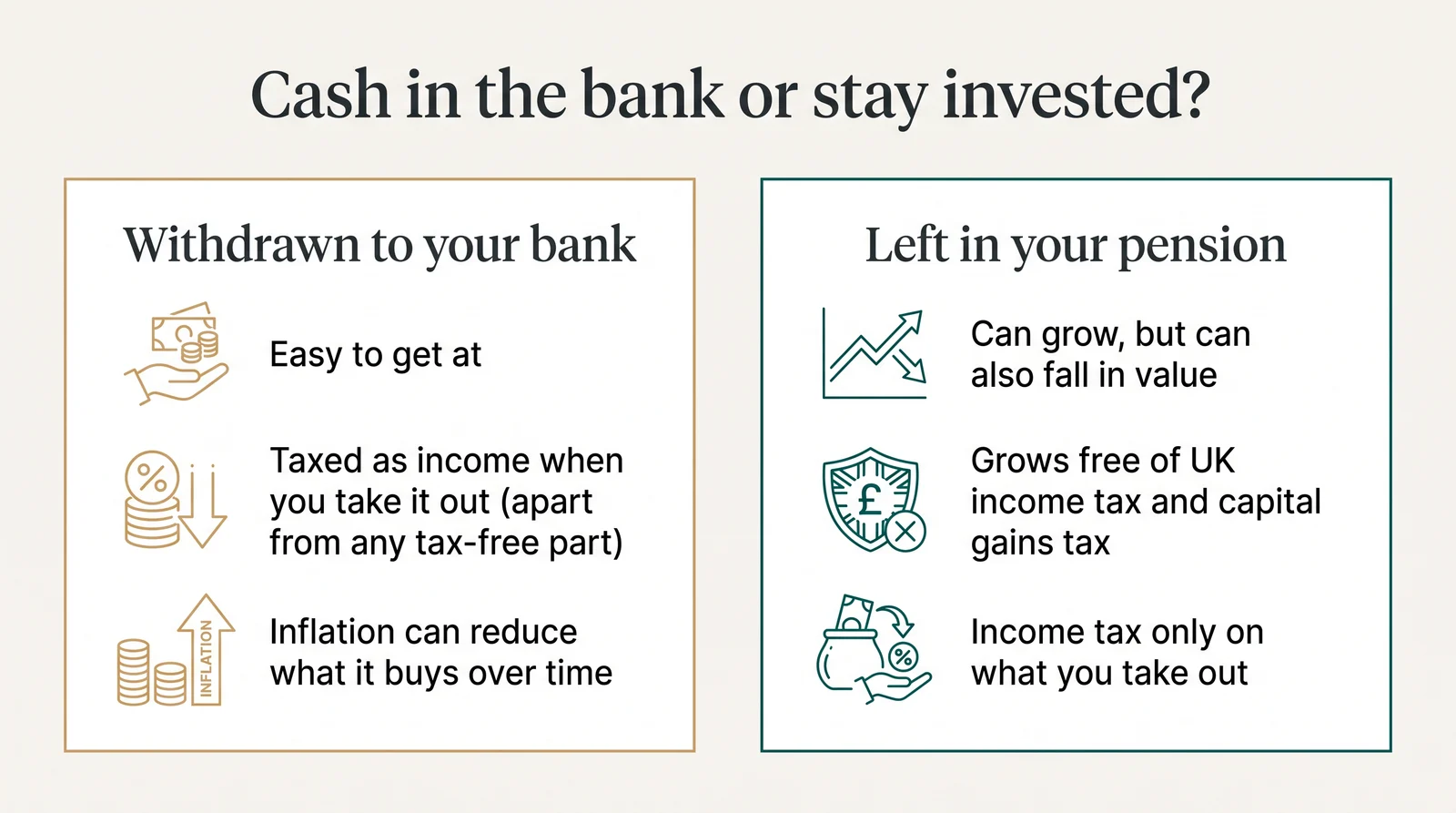
Whether you withdraw your pension to a bank account or keep it invested is a personal choice, but you need to understand what each means. Moving money into a bank account gives you immediate access, which can appeal if you have expenses coming up or prefer the security of cash. But over the long term, interest rates on savings accounts have often failed to keep pace with inflation, which can erode your buying power over time. Remember too that money outside your pension is no longer in a tax-free environment, so interest above your personal savings allowance may be taxed.
Staying invested gives you the potential for growth over time. A diversified portfolio has the potential to produce higher returns than cash over the long term, although this is not guaranteed. It tends to suit people with a longer time horizon who can accept market ups and downs. Investments can also help to protect against inflation over time, but again there is no guarantee.
Investing is more volatile than cash. Over long periods, diversified investments have historically tended to grow faster than cash, but past performance is not a reliable guide to the future, and you could get back less than you put in.
If you need money in the short term, often taken to mean less than five years, cash may be a better home for it. Many people in drawdown keep a cash buffer for the next year or two of spending and leave the rest invested for the longer term.
Can I withdraw all my pension at once?
You can withdraw all of a defined contribution pension at once, but think carefully about the tax and the effect on your retirement income. Usually only 25% of the amount is tax-free. The other 75% is taxed as income in that tax year, which could push you into a higher tax band.
Before taking everything, think about your long-term financial security. Once the money is out of your pension, you need to manage it so that it lasts the rest of your life. Immediate access can be tempting, but it could leave you short later.
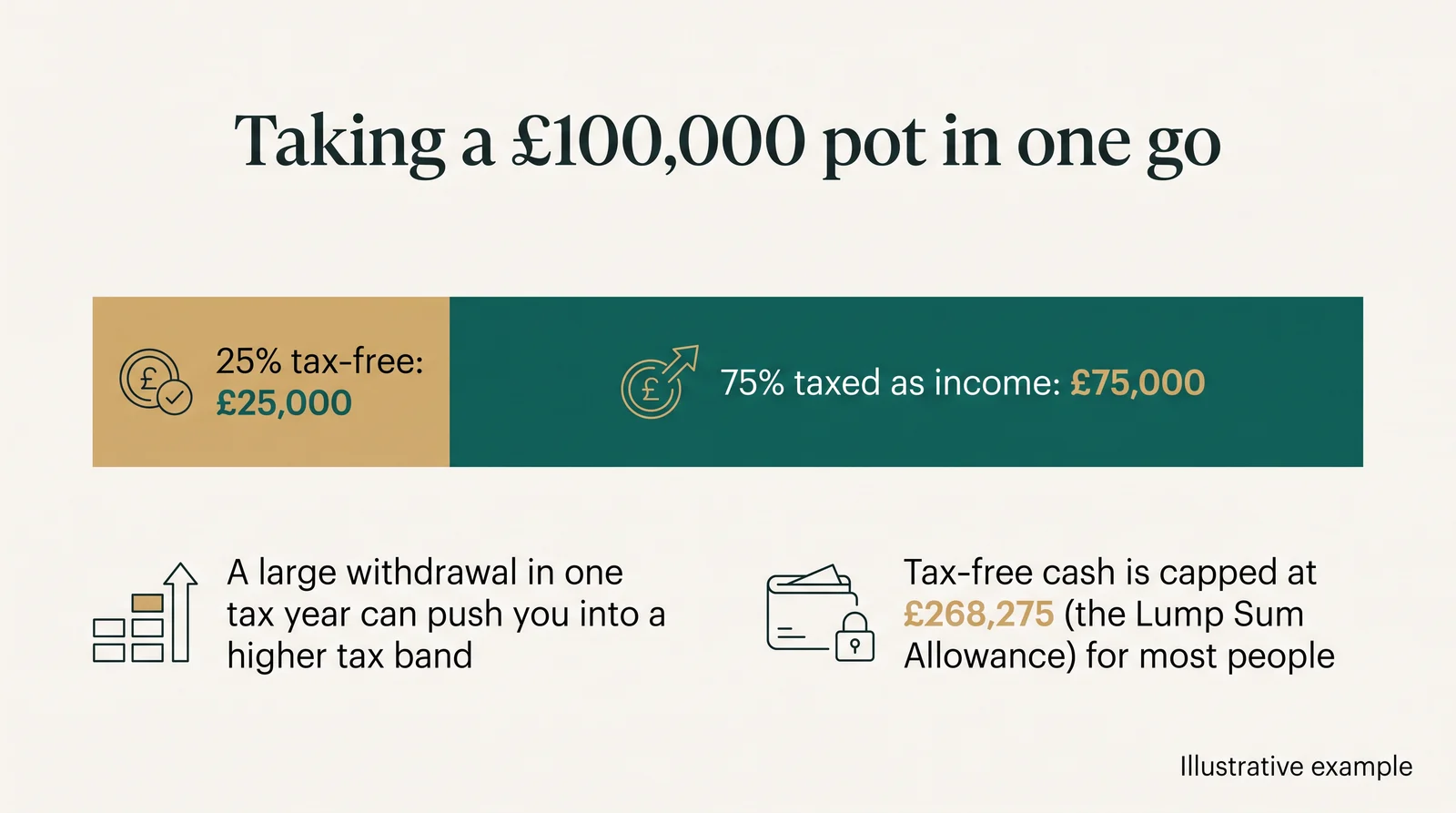
The tax can be significant. If you withdraw a large sum, the taxable part could produce a big tax bill. Work it out beforehand so you are not caught out.
For many people it makes more sense to take what they need, when they need it, rather than withdrawing everything at once.
Taking your pension as one lump sum can also affect your eligibility for means-tested benefits and how any debts are dealt with.
There are other knock-on effects too:
- The money purchase annual allowance. Once you take a taxable payment from a pension pot, future tax-relieved contributions to defined contribution pensions are usually limited to £10,000 a year.
- Inheritance tax. Unused pension funds and most death benefits are due to come into the scope of inheritance tax from 6 April 2027. Moving money out of a pension and into your bank account changes how it is treated for tax, so it is worth understanding the rules before you act.
- Scams. Large sums sitting in a bank account can attract fraudsters. Check the FCA ScamSmart site before acting on any unexpected investment offer.
Steps to withdraw your pension
To withdraw from your pension, you need to have reached the minimum pension age of 55 (57 from April 2028), or qualify for an exception such as ill health or a protected pension age. Then decide how much you want to take.
First, check your provider's terms and conditions for taking money out. They explain the process and whether your current plan offers the options you want. Some older plans do not offer drawdown or partial lump sums, so you may need to move to another plan to get them. Check what you could lose before you move.
Contact your provider for the forms or online process, or take regulated financial advice. You will need to complete the forms accurately and provide identification and bank details. These checks protect you from fraud.
If you take your whole pension without advice, your provider will not tell you whether that is the most tax-efficient choice. They will take your instructions and give you risk warnings, but they will not stop you. Regulated advice looks at your whole situation and the most tax-efficient and sensible way to take your money. If you take everything without advice and then face a large tax bill, you cannot reverse the decision.
Your provider will process the request, deduct any income tax due through PAYE and report it to HMRC, then pay the money into your bank account. Processing times vary, so follow up if there are delays.
How long does a withdrawal take?
Once your provider has your completed forms, the time it takes depends on several things. It is not as quick as a bank transfer, because your investments need to be sold and turned into cash first. Selling and settling investments can take from a few days to a week or so.
When you ask for a payment, your provider has to sell enough investments to cover it. How long that takes depends on what you hold. Some investments settle within a couple of days, others take longer.
Once the cash is available, how quickly it reaches you depends on the payment method. BACS can take up to three working days. CHAPS can arrive the same day but may cost extra. Faster Payments often arrive within hours, depending on the provider.
Providers also have their own payment schedules. Some only pay on a set date each month, in their income run, while others pay as soon as the money is available.
Ask your provider about their timescales so you can plan around them.
How withdrawals are taxed
Understanding the tax on pension withdrawals is an important part of planning. Not everything you receive will be tax-free. Usually 25% can be taken tax-free, up to the Lump Sum Allowance of £268,275 for most people, and the rest is taxable income. The Lifetime Allowance was abolished from 6 April 2024.
Flexible withdrawals let you take money in a way that suits you, but the taxable part is added to your other income for the year. That could push you into a higher tax band and increase your total tax bill.
How the tax is collected matters too. Your provider may use an emergency tax code on the first payment, which can mean paying too much tax at first. Plan your withdrawals carefully so that you are not paying more than you need to.
Example: emergency tax on a £20,000 withdrawal
This example shows how an emergency tax code could affect a single withdrawal of £20,000, with 25% (£5,000) tax-free. It assumes no other taxable income and uses 2026/27 income tax rates for England, Wales and Northern Ireland. Scotland has different rates. The figures are for illustration only.
Tax charged on a month 1 basis
| Tax rate | Amount taxed | Tax payable |
|---|---|---|
| 0% (tax-free cash plus one month's personal allowance) | £6,047.50 | £0.00 |
| 20% | £3,141.67 | £628.33 |
| 40% | £7,286.67 | £2,914.67 |
| 45% | £3,524.16 | £1,585.87 |
| Total | £20,000.00 | £5,128.87 |
Amount received after emergency tax: £14,871.13.
Amount you would end up with once the correct tax for the year is settled: about £19,514, because the full annual personal allowance would cover most of the taxable £15,000.
Reclaiming overpaid pension tax
If you have paid too much tax on a pension withdrawal, you can reclaim it from HMRC. This often happens when your provider uses an emergency tax code, especially on the first payment.
HMRC has different forms for different situations. For example, if you have taken your whole pot, you may need form P53Z, while forms P55 and P50Z cover other situations. See the gov.uk guidance on claiming back tax on a flexibly accessed pension and choose the right form to avoid delays. If you do not claim, HMRC usually corrects the position at the end of the tax year.
HMRC checks the claim and refunds any overpaid tax. This can take a few weeks. Keep copies of your claim and documents in case HMRC has questions.
Taking advice or guidance
Taking regulated financial advice is often worthwhile when you are deciding how to take your pension, so that you pay no more tax than you need to and your money lasts. An adviser can explain the consequences of each option and help you weigh up the risks for your situation.
An adviser can also help you explore alternatives. For example, instead of moving the whole pot into a bank account, you might use drawdown, an annuity, or a mix of both.
For free, impartial guidance, contact MoneyHelper or book a Pension Wise appointment. MoneyHelper also has a directory to help you find a regulated retirement adviser.
If you have a final salary pension and want to understand how transfers and the advice process work, you can book a free chat about how the process works. It is general information, not advice.
Frequently asked questions
Can I withdraw my pension pot to my bank account?
Yes. In most cases you can withdraw some or all of a defined contribution pension pot and have the money paid to your bank account once you reach the minimum pension age (55, rising to 57 on 6 April 2028). You can usually take up to 25% tax-free, and the rest is taxed as income at your marginal rate. Defined contribution pensions generally offer the most flexibility. Defined benefit (final salary) pensions usually pay a regular income rather than a lump sum.
Can I withdraw all my pension at once?
With a defined contribution pension you can generally withdraw the whole pot once you reach the minimum pension age. Usually only 25% is tax-free, up to the Lump Sum Allowance of £268,275, and the rest is taxed as income in that tax year, which could push you into a higher tax band. With a defined benefit pension you usually cannot take the whole fund as a lump sum without first transferring to a defined contribution pension. That means giving up a guaranteed income, and if the benefits are worth more than £30,000 you must take regulated advice first.
How long does it take to withdraw a pension to a bank account?
It varies by provider. Many withdrawals are paid within a few days to a few weeks once all the paperwork is complete. Some providers only pay on set dates each month. Older or more complex schemes may take longer. A defined benefit transfer to a SIPP before any money can be taken usually takes several months.
Do I pay tax when I withdraw my pension to my bank account?
Usually, yes. You can normally take up to 25% tax-free, up to the Lump Sum Allowance of £268,275. Anything above that is added to your income for the tax year and taxed at your marginal rate. Your provider may use an emergency tax code at first, which can mean paying too much; you can reclaim overpaid tax from HMRC.
What is the difference between withdrawing a pension and keeping it invested?
Withdrawing moves the money into your bank account, so the amount withdrawn is no longer invested in the pension, and the taxable part is taxed in the year you take it. Keeping it invested in drawdown means it can keep growing, you only pay tax on what you take, and growth inside the pension is free of income and capital gains tax. Drawdown is more flexible but carries investment risk. A full withdrawal gives certainty but can trigger a large tax bill.
This article is general information, not financial advice. Tax rules depend on your circumstances and can change. The value of investments can go down as well as up, and past performance is not a reliable guide to future returns.
Important: Arthur Browns Wealth Management Ltd (FCA 825843) does not give defined benefit pension transfer advice. The FCA starts from the position that a transfer is unlikely to be suitable for most people, and a transfer cannot usually be reversed. See Important information.
Related reading

Deferred final salary pensions: what happens when you leave
What a deferred final salary pension is, how it grows until you retire, taking it early or late, tracing a lost one, and the rules if you consider a transfer.
Reviewed 23 October 2026 · 9 min read

Enhanced transfer values (ETVs): what they are and the rules
What an enhanced transfer value is, why employers offer one, the industry code's ban on cash incentives, who pays for advice and questions to ask.
Reviewed 23 October 2026 · 9 min read

How long does a DB pension transfer take?
How long a defined benefit pension transfer takes: the 3-month CETV deadlines, the advice stages, scam checks under the 2021 rules and the 6-month limit.
Reviewed 23 October 2026 · 9 min read