Final salary pensions explained
A final salary pension pays you a guaranteed income for life, based on your salary and how long you were in the scheme. This guide explains how it works, how it grows and what to check, in plain English.
What is a final salary pension?
A final salary pension is a type of workplace pension that pays you a guaranteed income for life, worked out from your salary and the number of years you were a member of the scheme. The amount is set by the scheme's rules, not by how investments perform, so you know in advance broadly what you will get.
Final salary schemes are the best-known kind of defined benefit (DB) pension. The other common kind is a career average scheme, explained below. Both promise a set level of income, and the employer is responsible for making sure there is enough money to pay it. Private-sector schemes are run by trustees and overseen by The Pensions Regulator.
Unlike a defined contribution pension, a final salary pension doesn't give you a personal pot with a fund value. What you have built up is a promise of income. If you want to see what that promise is worth in cash terms, you can ask the scheme for a transfer value.
Most private-sector final salary schemes are now closed to new members, and many have also closed to further build-up. If you were a member in the past, the pension you built up is still yours, and it is still paid under the scheme's rules.
How your income is worked out
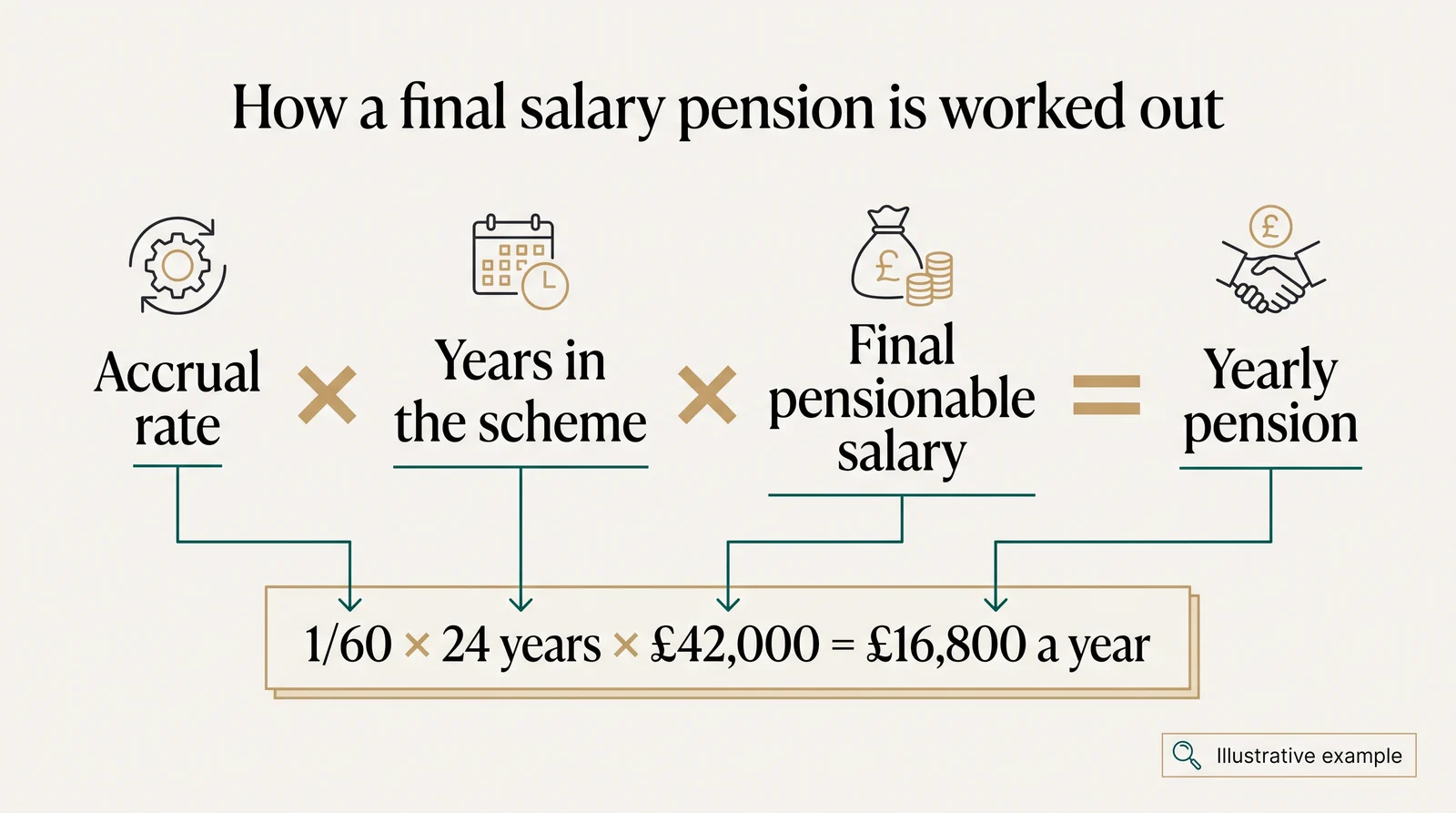
Most final salary schemes use the same basic formula:
accrual rate × pensionable service × final pensionable salary
- Accrual rate. The fraction of your salary you build up for each year of membership. Common rates are 1/60th and 1/80th. A 1/60th scheme builds up pension faster than a 1/80th scheme.
- Pensionable service. The years and months you were an active, paying member of the scheme.
- Final pensionable salary. Your scheme's rules define this. It might be your salary in your last year of membership, or an average of your best three consecutive years in the last ten. Some schemes leave out overtime, bonuses or allowances.
An illustrative example
Imagine Sarah, who was in a 1/60th scheme for 24 years. Her final pensionable salary was £42,000.
24 ÷ 60 × £42,000 = £16,800 a year, payable from the scheme's normal pension age, before any tax-free cash.
This is an illustrative example only. Your scheme's rules and your own figures will be different.
If you left the scheme some years ago, you are a "deferred member". Your pension is based on your salary and service when you left, and it is then increased each year until it is paid (see increases below).
Your annual benefit statement shows the pension you have built up. If you don't have a recent one, ask your scheme administrator.
Career average vs final salary
In a career average scheme, sometimes called CARE (career average revalued earnings), you build up a slice of pension each year based on that year's pay. Each slice is then increased every year until you retire, usually in line with inflation or by a rate the scheme sets. Your pension is the total of all the slices.
| Final salary | Career average | |
|---|---|---|
| Based on | Your salary at or near the end of membership | Your salary in each year of membership |
| Pay rises late in your career | Boost the whole pension | Only boost the years they apply to |
| Increases while still working | Come through your salary | Each year's slice is revalued |
| Who carries the investment risk | The employer | The employer |
Many employers moved from final salary to career average to manage costs. Most of the main public-sector schemes changed to a career average design in 2014 or 2015, so many public-sector workers have benefits in both types of section.
Both are defined benefit pensions, and both give you a guaranteed income for life. Members of the unfunded public-sector schemes, such as the NHS, Teachers' and Civil Service schemes, can't transfer to a defined contribution pension. Find out why.
Increases before and after you retire
Before you retire: revaluation
If you leave a scheme before retirement, your deferred pension is increased each year until it starts to be paid. This is called revaluation. By law, most deferred pensions must be increased at least in line with inflation, up to a cap:
- pension built up before 6 April 2009: inflation capped at 5% a year, measured over the whole period until retirement
- pension built up from 6 April 2009: inflation capped at 2.5% a year
Many schemes now use the Consumer Prices Index (CPI) and some use the Retail Prices Index (RPI). Your scheme's rules may be more generous than the legal minimum. If part of your pension is a Guaranteed Minimum Pension, that part is revalued under separate rules.
After you retire: increases in payment
Once your pension is being paid, the law requires minimum yearly increases on most pension built up after April 1997:
- pension built up from 6 April 1997 to 5 April 2005: in line with inflation, up to 5% a year
- pension built up from 6 April 2005: in line with inflation, up to 2.5% a year
There is no general legal requirement to increase pension built up before April 1997, apart from part of any Guaranteed Minimum Pension, although many schemes do. Some schemes pay fixed increases, such as 3% a year, and some pay more than the minimum. Your scheme booklet explains exactly what applies to you.
These increases are one of the most valuable parts of a final salary pension, because they help protect your income from rising prices for the rest of your life.
Tax-free cash and commutation
Most final salary schemes let you take a tax-free lump sum when you retire, in exchange for a lower yearly pension. Giving up pension for cash is called commutation.
The rate the scheme uses is called the commutation factor. A factor of 12 means you get £12 of tax-free cash for each £1 a year of pension you give up.
Illustrative example: if Sarah gave up £3,000 a year of her £16,800 pension at a factor of 12, she would get a tax-free lump sum of £36,000 and a pension of £13,800 a year. Her actual factor would depend on her scheme and her age.
Some things to know:
- Commutation factors vary between schemes and can change. Some give you less in cash than it would cost to replace the pension you give up, so it helps to understand the figure before you decide.
- HMRC rules usually limit tax-free cash to around 25% of the value of your benefits, measured using a set formula, and within the Lump Sum Allowance of £268,275 for most people. The Lifetime Allowance was abolished from 6 April 2024.
- Some schemes, especially older public-sector sections, pay an automatic lump sum on top of the pension.
- The pension you receive is taxable income, usually taxed through PAYE.
MoneyHelper has free guides on taking tax-free cash from a defined benefit pension.
Early and late retirement
Every scheme has a normal pension age, often 60 or 65. That is when your full pension is payable without any reduction.
Taking your pension early
Most schemes let you take your pension early, usually from the normal minimum pension age. That is currently 55, and it rises to 57 on 6 April 2028. Some people have a protected pension age that lets them take benefits earlier.
If you retire early, your pension is normally reduced to reflect that it will be paid for longer. The reduction is set by the scheme's early retirement factors and can be significant if you retire several years early. Your scheme can give you a quote showing the reduced figure.
If you have to stop work because of ill health, your scheme may pay an ill-health pension earlier, with a smaller reduction or none at all, depending on its rules.
Taking your pension late
Some schemes let you take your pension after normal pension age. Your pension is then usually increased by a late retirement factor, because it will be paid for a shorter time. Check your scheme's rules, as not all schemes offer this.
The government's guide to early retirement and your pension has more general information.
Spouse's and dependants' pensions
Most final salary schemes pay a pension to your husband, wife or civil partner if you die. A common level is half of your pension, although some schemes pay more. Some schemes also pay a pension to an unmarried partner who was financially dependent on you, and to children while they are young or in full-time education.
Other features you may find:
- A guarantee period. Some schemes keep paying your full pension for a set time, often five years, if you die soon after retiring.
- Death before retirement. Many schemes pay a lump sum, a survivor's pension, or both, if you die before you take your pension.
- Increases. Survivors' pensions usually increase each year in the same way as your own pension.
Make sure your scheme has an up-to-date expression of wish form, so the trustees know who you would like to benefit.
From 6 April 2027, unused pension funds and most pension death benefits are due to come into the scope of inheritance tax. How this applies to anything paid from a final salary pension when you die will depend on the final rules and your scheme. Read more in the 2027 pension inheritance tax changes.
What happens if your employer goes bust: the PPF
If your employer becomes insolvent and your scheme doesn't have enough money to pay members' pensions, the Pension Protection Fund (PPF) may step in and pay compensation.
In general terms:
- if you have reached your scheme's normal pension age, or you are already receiving an ill-health or survivor's pension, the PPF usually pays 100% of your pension
- if you are below normal pension age, it usually pays 90%
- yearly increases on PPF compensation are more limited than in many schemes, especially for pension built up before April 1997
The rules can change, so check the PPF's website for the current position. Public-sector schemes are not covered by the PPF, because they are backed by the government or by law.
Worrying about your employer is understandable, and it is a common reason people look into a transfer. The PPF is there to provide a safety net, and the risks of a transfer need to be weighed against it.
How to find a lost final salary pension
It's easy to lose track of a pension from a job you left years ago, especially if the employer has since changed its name, merged or closed.
- Gather what you know. The employer's name, roughly when you worked there, and the scheme's name if you remember it.
- Use the free Pension Tracing Service. The government's Pension Tracing Service can give you current contact details for a workplace or personal pension scheme. It doesn't tell you whether you have a pension or what it is worth.
- Contact the scheme. Give them your National Insurance number, date of birth, the dates you worked there and any old addresses. They can confirm what you have and send you a statement.
- If the scheme moved into the PPF, contact the PPF instead.
The Pension Tracing Service is free. Be wary of companies that offer to trace pensions for a fee, or that contact you out of the blue about an old pension. Check the FCA's ScamSmart site if you're unsure.
Can you transfer a final salary pension?
In many cases, yes. If you have not started taking your pension, most private-sector schemes and the Local Government Pension Scheme let you ask for a cash equivalent transfer value (CETV) and move it into a defined contribution pension. Members of unfunded public-sector schemes can't do this.
A transfer means giving up your guaranteed income for life in exchange for an invested pot. A few key points:
- The FCA starts from the position that a transfer is unlikely to be suitable for most people. Advisers must assume a transfer won't be suitable unless it can be clearly shown to be in your best interests. See the FCA's guide to defined benefit pension transfers.
- Advice is legally required over £30,000. If your safeguarded benefits are worth more than £30,000, you must take advice from an FCA-authorised firm with the pension transfer permission before you can transfer.
- A transfer cannot usually be reversed.
Our main guide explains how defined benefit pension transfers work in more detail.
We do not give defined benefit pension transfer advice. We offer a free, no-obligation chat explaining how transfers and the advice process work, and if you want regulated advice, we can introduce you to an FCA-authorised firm that holds the pension transfer permission. Arthur Browns may receive a fee from the firm we introduce you to if you become their client.
Frequently asked questions
Is a final salary pension the same as a defined benefit pension?
A final salary pension is one type of defined benefit pension. "Defined benefit" covers any pension where the income is set by a formula, including career average schemes. People often use the two terms to mean the same thing.
What is my final salary pension worth?
Your pension's main value is the guaranteed, increasing income it pays for life, plus any benefits for your spouse or dependants. If you want a cash figure, you can ask your scheme for a transfer value. A transfer value is not the same as what it would cost you to buy the same guaranteed income elsewhere, and a high figure is not, on its own, a reason to transfer.
Can I take my final salary pension at 55?
Many schemes allow it, but your pension will usually be reduced for early payment. The normal minimum pension age rises from 55 to 57 on 6 April 2028, unless you have a protected pension age. Ask your scheme for an early retirement quote.
What happens to my final salary pension if I change jobs?
It stays in the scheme as a deferred pension. It is increased each year under the scheme's rules until you take it, and you keep any benefits for your spouse or dependants.
Do I pay tax on a final salary pension?
The pension is taxed as income, in the same way as a salary, usually through PAYE. Any tax-free lump sum you take when you retire is tax-free within the limits explained above. See the government's guide to tax on your private pension.
Can I cash in a small final salary pension?
If your pension is small, HMRC rules may let you take it all as a one-off lump sum, part tax-free and part taxed as income. Your scheme can tell you whether this is possible for you.
Is my final salary pension safe?
Your benefits are set by the scheme's rules and your employer must fund them. Private-sector schemes are regulated by The Pensions Regulator, and if your employer becomes insolvent and the scheme can't pay, the PPF may pay compensation.
Can I talk to someone about how transfers work?
Yes. You can book a free chat about how final salary transfers and the advice process work. It's general information, not advice. MoneyHelper and Pension Wise also offer free, impartial guidance.
Important: Arthur Browns Wealth Management Ltd (FCA 825843) does not give defined benefit pension transfer advice. The FCA starts from the position that a transfer is unlikely to be suitable for most people, and a transfer cannot usually be reversed. See Important information.
Last reviewed 22 October 2026