Guide
Partial Defined Benefit Pension Transfer: A 2026 Guide


A partial defined benefit (DB) pension transfer means moving only part of your DB pension into a defined contribution (DC) pension, such as a SIPP, while keeping the rest as a guaranteed income from the scheme. Not every scheme offers it, and the same legal advice requirement applies as for a full transfer. The FCA's starting assumption is still that giving up DB benefits is unlikely to be suitable for most people.
Many people assume a DB transfer is all or nothing. Some schemes do allow a middle route. This guide explains how partial transfers work, why people look at them, the risks, and what the process involves.
Quick summary
- A partial DB transfer moves part of your pension rights into a flexible pot, while you keep some guaranteed income
- Availability varies: not all schemes offer partial transfers
- People who look at them usually want some flexibility alongside a guaranteed income floor
- If your safeguarded benefits are worth more than £30,000, you must take regulated advice from an adviser with the pension transfer permission first
- Current allowances: Lump Sum Allowance (LSA) £268,275 and Lump Sum and Death Benefit Allowance (LSDBA) £1,073,100
What Is a Partial Defined Benefit Pension Transfer?
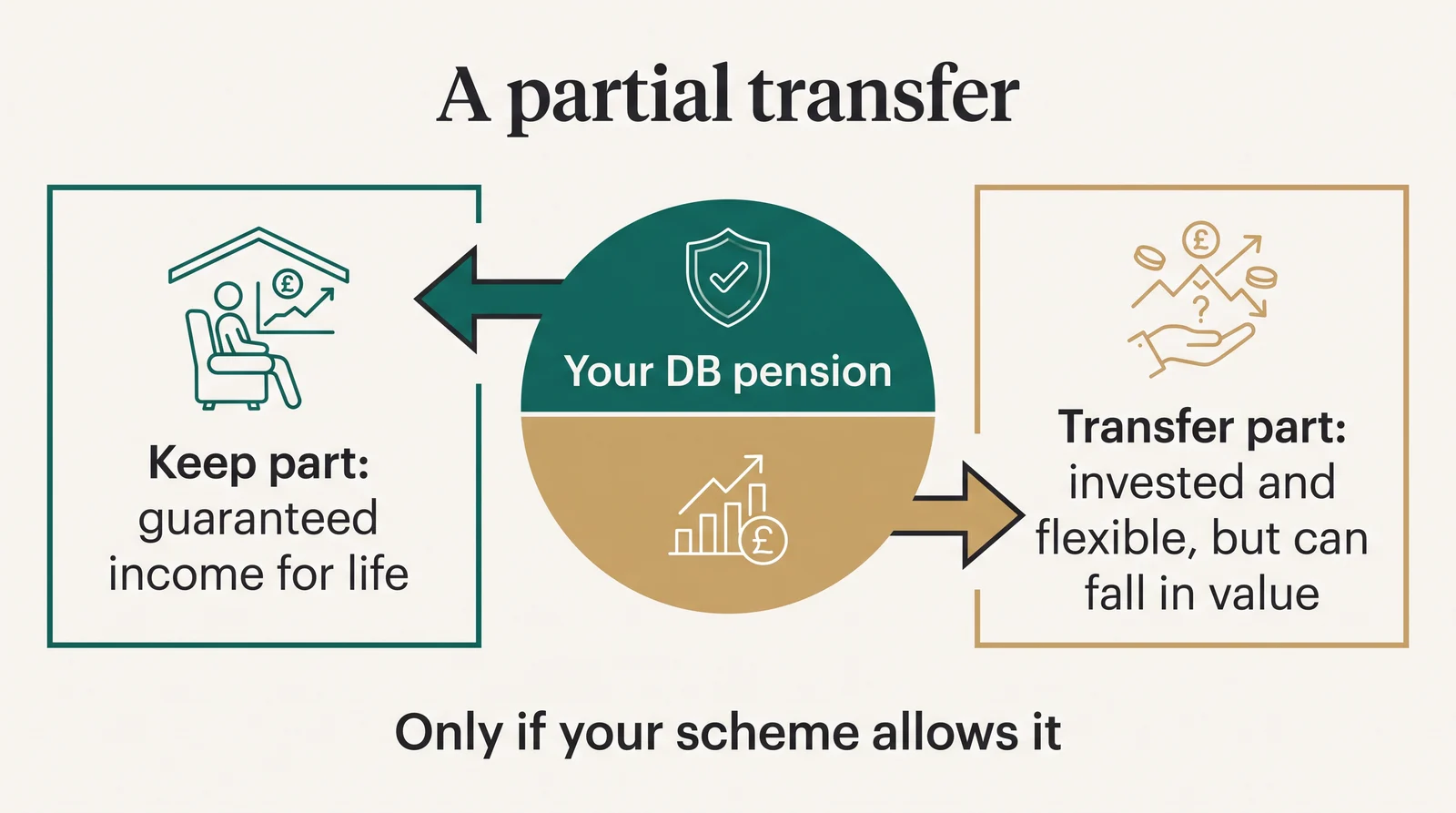
A defined benefit pension, often called a final salary or career average pension, provides a guaranteed income for life, usually based on your salary and years of service. Once it is in payment, that income is largely set by the scheme rules, including how it increases each year. That gives certainty but limited flexibility.
A partial defined benefit transfer lets you transfer part of your accrued pension rights into a personal pension, such as a self-invested personal pension (SIPP), and keep the rest in the original scheme. The part you keep still pays a guaranteed income at retirement. The part you transfer is invested and can be accessed under the pension freedom rules.
In a full transfer, by contrast, you give up all your DB benefits in exchange for a Cash Equivalent Transfer Value (CETV), a lump sum that is then invested in a personal pension. Our page on the transfer value of a pension explains how CETVs work.
Why Do People Look at a Partial Transfer?
The appeal of a partial transfer lies in trying to balance two priorities: security and flexibility. These are the main reasons people explore it. Each one is a trade-off, not a reason to transfer on its own.
1. Keeping a Guaranteed Income Floor
One of the biggest risks of a full transfer is giving up a guaranteed income completely. For many people, a reliable, inflation-linked income that covers essential costs such as housing, bills and food brings real peace of mind. A partial transfer keeps some of that guaranteed income while giving more flexibility with the rest.
2. Access to Pension Freedoms
Since the pension freedoms were introduced in April 2015, DC pensions have offered much more flexibility than DB schemes. You can draw income at a pace that suits you, leave money invested for longer, or vary withdrawals as your needs change. A partial transfer gives that flexibility for part of your savings without giving up all of your guaranteed income.
3. Death Benefits
DB schemes usually pay a pension to a surviving spouse or civil partner, but benefits for other people, such as adult children, may be limited or not available. DC pensions can usually pass unspent funds to whoever you nominate.
From 6 April 2027, unused pension funds and most pension death benefits are due to come into the scope of inheritance tax. That reduces the inheritance advantage of a DC pension and is an important change for anyone thinking about a transfer for estate planning reasons. Our article on the 2027 pension IHT overhaul explains it.
4. Tax-Free Cash
Some people find their DB scheme's tax-free cash terms (known as commutation) are less generous than 25% of a transferred fund would be. A partial transfer could change how much tax-free cash is available, within the Lump Sum Allowance of £268,275, while the scheme still pays an income. This needs careful comparison, because taking tax-free cash from either source reduces the income that is left.
5. Flexibility Around Retirement Age
DB schemes have a normal pension age, and taking benefits early usually means a reduction. A personal pension can normally be accessed from age 55, rising to 57 on 6 April 2028 (some people have a protected pension age). A partial transfer could allow earlier, flexible access to part of your savings while the rest of your DB pension waits until its normal pension age.
Who Offers Partial DB Transfers?
Partial transfers have never been universally available, and many schemes do not offer them. Whether you can do one depends on:
- Scheme rules: the scheme's trust deed and rules must allow a partial transfer. Not all do.
- Scheme administration: larger schemes with more resources are more likely to offer them. Smaller schemes may not have the systems to calculate and administer split benefits.
- Trustee discretion: even where the rules allow it, trustees may have discretion over whether and how partial transfers are offered.
- Legal and tax rules: the remaining benefits must be calculated correctly and the transfer must meet the relevant pension and tax rules.
If you are interested, the first step is to ask your scheme administrator whether a partial transfer is available and what the process involves. An adviser with the pension transfer permission can help you interpret the scheme's answer if you go on to take advice.
Note that unfunded public sector schemes, such as the NHS, Teachers', Police, Firefighters', Civil Service and Armed Forces schemes, cannot transfer to a DC pension at all. The Local Government Pension Scheme is funded and can transfer. Our guide to public sector pensions explains more.
How Is the CETV Worked Out for a Partial Transfer?
For a full transfer, the scheme calculates a CETV using actuarial assumptions about investment returns, inflation and life expectancy. For a partial transfer, it calculates the transfer value for the portion being moved and adjusts the pension you keep.
Transfer values have generally been lower in recent years than at their peak in 2021 and 2022. The main reasons are:
- Long-term gilt yields have risen from their lows, which reduces the amount a scheme needs to hold today to pay a future pension
- The discount rates used to calculate CETVs have increased as a result
- Scheme funding has generally improved, which changes how trustees and employers approach transfers
Before deciding anything, you need to understand the CETV and what it represents compared with the benefits you would give up. A regulated adviser will carry out an appropriate pension transfer analysis (APTA), which includes a transfer value comparator. This compares the transfer value with an estimate of what it would cost to buy similar benefits elsewhere.
The Regulatory Position in 2026
DB pension transfers are heavily regulated in the UK. The FCA has said repeatedly that, for most people, transferring out of a DB scheme is unlikely to be in their best interests. The main rules are:
- Advice requirement: by law, if your safeguarded benefits are worth more than £30,000, you must take advice from an FCA-authorised adviser with the pension transfer permission before you can transfer. The test looks at the value of your safeguarded benefits in the scheme, so ask your scheme how it applies to a partial transfer.
- Appropriate pension transfer analysis: the adviser must carry out a detailed analysis comparing the transfer with staying in the scheme.
- Starting assumption: advisers must start from the assumption that a transfer is unsuitable, and only recommend one if they can clearly show it is in your best interests.
- Charging: since 1 October 2020, contingent charging (charging only if you go ahead) has been banned for most DB transfer advice, with carve-outs for serious ill health and serious financial hardship.
These rules apply to partial and full transfers alike.
Important regulatory note: Only an FCA-authorised firm with the pension transfer permission, using a qualified pension transfer specialist, can give the advice the law requires. You can check a firm's permissions on the FCA Register.
Key Risks of a Partial DB Transfer
Even a partial transfer carries significant risks.
Investment Risk
The transferred portion moves from a guaranteed pension into investments, usually funds, whose value can fall as well as rise. Unlike the DB pension you keep, there is no guaranteed income from the transferred pot.
Longevity Risk
One of the main strengths of a DB pension is that it pays for life. A personal pension pot is finite. If you live longer than expected, or draw too much too early, you could run out of money from that pot.
Charges and Costs
Personal pensions have ongoing costs, such as fund charges, platform fees and ongoing adviser charges. Over many years these reduce returns. Any analysis should use realistic assumptions about charges.
Loss of Guaranteed Benefits
A partial transfer permanently reduces your guaranteed income. It cannot be undone. The benefits you give up, such as inflation protection, lifelong payment and a spouse's pension, may prove more valuable than the flexibility you gain.
Scheme and Employer Insolvency
If your employer becomes insolvent and the scheme cannot pay its benefits, the Pension Protection Fund (PPF) provides compensation, but only for benefits still in the scheme. Money you have transferred out is not covered by the PPF. Instead, the protection for a personal pension depends on how it is held. The Financial Services Compensation Scheme (FSCS) may cover you if a provider or adviser fails, up to its limits, but it does not protect you against investment losses.
What a Regulated Adviser Would Weigh
A partial DB transfer is not a one-size-fits-all answer. An adviser with the pension transfer permission would look at the full picture, including:
- How much of your essential spending the DB pension covers, and what other secure income you have, such as the State Pension
- The size of the DB pension compared with your needs, and what the remaining guaranteed income would be after a partial transfer
- Your other savings and pensions, and whether they already give you the flexibility you want without touching the DB pension
- Your attitude to risk and capacity for loss, including how you would cope if the transferred fund fell in value
- Your health, your age and how long you might need the income to last
- Your family and dependants, including the value of any spouse's pension you would give up
- The terms the scheme offers, including the CETV for the part being transferred
- The tax position, including the 2027 inheritance tax changes
The FCA's starting assumption applies to every part of this analysis. A good adviser will explain clearly why they reach their conclusion, which may well be to keep all of your DB pension.
The Partial Transfer Process: What to Expect
If you decide to explore a partial transfer, the process usually looks like this:
- Contact your scheme: ask whether partial transfers are available and request a CETV for the portion you are thinking of transferring.
- Take regulated advice: you will need advice from an FCA-authorised adviser with the pension transfer permission. They will carry out the appropriate pension transfer analysis.
- Receive a suitability report: the adviser must give you a written report explaining their recommendation and the reasons for it.
- Choose a receiving pension: a transfer needs a personal pension to receive it. The adviser's recommendation will cover this if a transfer is recommended.
- The transfer: once the paperwork is complete, the scheme pays the transfer value to the receiving pension. This can take several months. A CETV is usually guaranteed for three months from its guarantee date.
Tax Implications of a Partial DB Transfer
A transfer from one registered pension scheme to another is generally not taxed in itself. The main tax points are:
- Lump Sum Allowance (LSA): £268,275 for most people. This caps the total tax-free cash you can take from all your pensions in your lifetime.
- Lump Sum and Death Benefit Allowance (LSDBA): £1,073,100 for most people. This caps the total tax-free lump sums paid in your lifetime and on death before 75.
- Money Purchase Annual Allowance (MPAA): a transfer does not count towards your annual allowance. But once you take taxable income flexibly from a DC pension, the MPAA of £10,000 a year applies to future DC contributions.
- Inheritance tax from April 2027: unused DC pension funds are due to count towards your estate. DB dependants' pensions are expected to stay outside IHT, so the difference between the two is an important estate planning point.
MoneyHelper explains the pension tax rules in more detail.
Getting Regulated Advice and Help
A partial DB transfer involves complex trade-offs: guaranteed income against flexibility, security against legacy, and access now against security later. The decision needs careful, personal analysis.
An adviser with the pension transfer permission would typically:
- Help you understand whether your scheme offers a partial transfer and on what terms
- Carry out the appropriate pension transfer analysis
- Model retirement income with and without a partial transfer
- Consider your wider finances, health, attitude to risk and estate planning aims
- Give you a written suitability report setting out their recommendation and reasons
Free, impartial guidance is available from MoneyHelper, and if you're 50 or over you can book a Pension Wise appointment about your DC pensions. Be wary of anyone who contacts you out of the blue about your pension, and check the FCA's ScamSmart pages first.
I don't give pension transfer advice. If it would help, you can book a free, no-obligation chat about how DB transfers and the advice process work. It's general information, not advice. If you then want regulated advice, I can introduce you to an FCA-authorised firm that holds the pension transfer permission. Arthur Browns may receive a fee from the firm we introduce you to if you become their client. Introductions are for UK residents with a transfer value of £50,000 or more. Below that, MoneyHelper is a good place to start.
This article is general information, not advice. Please read our important information.
Frequently asked questions
What is a partial defined benefit pension transfer?
A partial defined benefit (DB) pension transfer lets you move part of your DB pension rights into a personal pension, such as a SIPP, while keeping some guaranteed income from the original scheme. It is an alternative to a full transfer, where you give up all your DB benefits in exchange for a Cash Equivalent Transfer Value (CETV).
Is a partial DB pension transfer available from all schemes?
No. It depends on the scheme's rules and how it is administered, and many schemes do not offer partial transfers. Unfunded public sector schemes, such as the NHS and Teachers' schemes, cannot transfer to a DC pension at all. Ask your scheme administrator whether a partial transfer is available and on what terms.
Do I need financial advice for a partial DB pension transfer?
If your safeguarded benefits are worth more than £30,000, the law requires you to take advice from an FCA-authorised adviser with the pension transfer permission before transferring. The adviser must carry out an appropriate pension transfer analysis and give you a written suitability report.
What are the main risks of a partial DB pension transfer?
The main risks are investment risk (the transferred part is invested, not guaranteed), longevity risk (a personal pension pot can run out), the permanent loss of some guaranteed income, ongoing charges reducing returns, and the fact that money you transfer out is no longer covered by the Pension Protection Fund if your employer fails.
How does the 2027 pension IHT change affect partial DB transfers?
From 6 April 2027, unused pension funds and most pension death benefits are due to come into the scope of inheritance tax. Money moved into a personal pension could therefore count towards your estate, while DB dependants' pensions are expected to stay outside IHT. Any regulated advice would need to take this into account.
Important: Arthur Browns Wealth Management Ltd (FCA 825843) does not give defined benefit pension transfer advice. The FCA starts from the position that a transfer is unlikely to be suitable for most people, and a transfer cannot usually be reversed. See Important information.
Related reading

Deferred final salary pensions: what happens when you leave
What a deferred final salary pension is, how it grows until you retire, taking it early or late, tracing a lost one, and the rules if you consider a transfer.
Reviewed 23 October 2026 · 9 min read

Enhanced transfer values (ETVs): what they are and the rules
What an enhanced transfer value is, why employers offer one, the industry code's ban on cash incentives, who pays for advice and questions to ask.
Reviewed 23 October 2026 · 9 min read

How long does a DB pension transfer take?
How long a defined benefit pension transfer takes: the 3-month CETV deadlines, the advice stages, scam checks under the 2021 rules and the 6-month limit.
Reviewed 23 October 2026 · 9 min read