Guaranteed annuity rates (GARs) explained
Some older pensions come with a valuable promise. Here's how to find out if yours does, what conditions usually apply, and what your options are.
By Phillip Handley, Chartered Financial Adviser (LIBF), Adv DipFA
What is a guaranteed annuity rate?
A guaranteed annuity rate (GAR) is a promise, written into some older pensions, to turn your pension pot into a lifetime income at a fixed rate set when the plan began. Many GARs are more generous than today's annuity rates, so check for one before you decide anything.
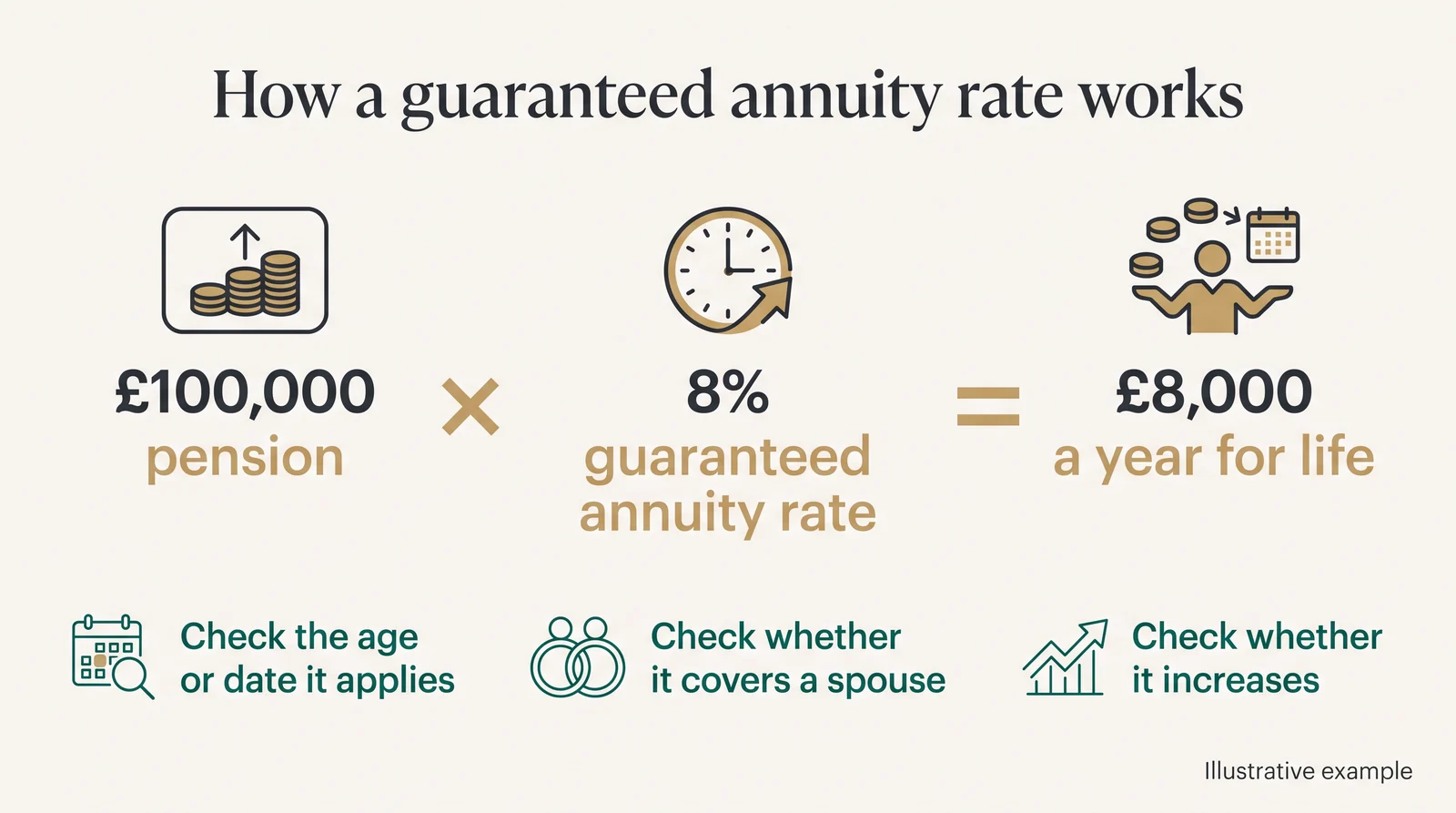
The promise is made when the pension is set up, and it normally stays with the policy unless you give it up or it lapses under the policy terms. GARs are mainly found on personal pensions, retirement annuity contracts and some occupational money purchase schemes started before the early 2000s.
For example, a GAR of 8% on a £100,000 pension would pay a guaranteed income of £8,000 a year. Many GARs are higher than the annuity rates generally available today, which is why they can be so valuable.
The rate is usually expressed as a percentage of the pot, or as an amount of yearly income for every £1,000 or £100 of pension fund. However it is written, the point is the same: the provider has promised a set level of income in exchange for your pot, whatever annuity rates happen to be on the open market when you retire.
Why GARs can be so valuable now
GARs were written into many policies sold before the early 2000s. When many of those policies were sold, interest rates were generally higher than they have been for much of the time since, and people were not expected to live as long in retirement as they are today. Insurers set the guaranteed rates with those conditions in mind.
Two things have changed since then:
- People are living longer. An annuity has to pay out for life, so the longer people are expected to live, the less income an insurer can offer for each pound of pension.
- Interest rates have been lower for long periods. Annuity rates broadly follow the returns insurers can get on long-term gilts and bonds. When those returns are low, annuity rates are low too.
The result is that many guaranteed rates promised decades ago are more generous than the rates an insurer would offer for a new annuity today. The gap is not fixed. It changes as interest rates and gilt yields move, and it depends on the exact terms of your guarantee, your age and the type of income you want. That is why we don't quote "typical" rates here. The only way to know what your guarantee is worth is to get the details of your own policy from your provider and compare them with the options open to you at the time.
A GAR is also the insurer's risk, not yours. If annuity rates on the open market fall further, the insurer still has to honour the guaranteed rate.
Which pensions have GARs?
GARs are most often found on:
- Retirement annuity contracts (RACs), sometimes called section 226 policies. These were the personal pensions of their day for the self-employed and for employees who weren't in an employer's pension scheme, and no new contracts could be taken out from 1 July 1988. Read more in our guide to retirement annuity contracts.
- Older personal pensions, especially those set up in the late 1980s and 1990s.
- With-profits policies, where the guarantee often sits alongside guaranteed bonuses.
- Some section 32 buy-out policies, which hold benefits taken out of an old employer's final salary scheme and may also include a Guaranteed Minimum Pension. See our guide to section 32 buy-out plans.
- Some older occupational money purchase schemes.
Not every policy of this kind has a GAR, and some have a guarantee on only part of the pot, for example the premiums paid before a certain date. The policy documents and the provider are the only reliable sources.
Conditions that often apply
A GAR is valuable, but it usually comes with conditions. These vary from policy to policy, so treat this as a list of things to check rather than a description of your plan:
- A set age or date. Many GARs can only be used at a particular age, such as 60 or 65, or on a set retirement date chosen when the policy started. Taking benefits earlier or later may mean the guarantee doesn't apply.
- Single life. Many GARs are set up for one person, with no pension for a spouse or partner after you die. Adding a partner's pension may mean a lower rate, or the guarantee may not cover it at all.
- Level income. Many guaranteed annuities don't increase each year, so inflation reduces what the income can buy over time.
- Payment terms. The guarantee may assume a particular payment frequency, such as yearly in arrears, and may or may not include a guarantee period.
- Tax-free cash. Taking a tax-free lump sum normally reduces the pot that is turned into income at the guaranteed rate. Some providers calculate the tax-free cash and the guaranteed income in a particular way, so ask for figures both with and without it.
- Same provider. To get the guaranteed rate you usually have to take the annuity from your existing provider. If you move the pot elsewhere, the guarantee normally ends.
- With-profits terms. If the policy is with-profits, moving it at certain times may trigger a market value reduction, and you may lose a final bonus.
How to check if your pension has one
- Look at your latest pension statement or the original policy documents.
- Ask your pension provider whether your plan has a guaranteed annuity rate, and on what terms.
- Ask what age or date the GAR applies from. Many GARs can only be used at a set age, such as 60 or 65, or on a set date.
If you miss that date or transfer away, you may lose the guarantee.
Questions to ask your provider
A short letter or email to your provider can save a lot of guesswork. You could ask:
- Does my policy have a guaranteed annuity rate, or any other guarantee about the income I can buy?
- What is the guaranteed rate, and does it apply to the whole fund or only part of it?
- At what age or on what date can I use it, and what happens if I take my benefits earlier or later?
- Is the guaranteed income paid for my life only, or can it include a pension for my spouse or partner? On what terms?
- Does the guaranteed income increase each year, or is it level?
- How would taking tax-free cash affect the guaranteed income? Please show figures with and without tax-free cash.
- What is the current fund value, and what is the transfer value? Is there a market value reduction or exit charge?
- Can I use the guarantee on part of the fund and keep or move the rest?
- If I die before taking benefits, what would be paid out?
- Please send me an illustration of the income the guarantee would provide at my GAR date.
Keep the replies with your policy documents. They are exactly what an adviser will need to see.
GARs are safeguarded benefits
The law treats a guaranteed annuity rate as a safeguarded benefit. Under section 48 of the Pension Schemes Act 2015, safeguarded benefits are any pension benefits other than money purchase and cash balance benefits. A pot with a GAR is built up like a money purchase pension, but because the income it can buy is guaranteed, it is not a pure money purchase benefit. The legislation calls this type of benefit a safeguarded-flexible benefit: one that is calculated by reference to an amount available for the member, but carries a guarantee. The FCA also states that a pension policy with a GAR has a safeguarded benefit (PERG 12.6).
Because a GAR is a safeguarded benefit, the FCA's starting assumption is that giving it up is unlikely to be suitable for most people, and advice is required if the benefits are worth more than £30,000. In practice this means:
- The FCA starting assumption. Under the FCA's rules (COBS 19.1.6G), an adviser must start by assuming that a transfer or conversion of safeguarded benefits will not be suitable, and should only recommend it if they can clearly show it is in your best interests. The FCA explains its approach on its pension transfer page.
- The £30,000 advice requirement. If your safeguarded benefits in the plan are worth more than £30,000, your provider must check that you have taken regulated advice before you can transfer to a pension without the guarantee, convert the benefits into flexible ones, or take an uncrystallised funds pension lump sum. Since 6 April 2018, the £30,000 test has been based on the transfer value of the benefits.
- Risk warnings. Since 6 April 2018, schemes have had to send members with safeguarded-flexible benefits a personalised risk warning before they give up the guarantee. It must say that the benefits include a potentially valuable guarantee that will be lost, explain the guarantee, and include illustrations based on your own policy. Read it carefully.
The same rules apply to defined benefit pensions, which are also safeguarded benefits. Our guide to safeguarded benefits explains the rules in more detail.
Things to know about GARs
Possible advantages
- A guaranteed income for life
- Often a higher rate than is available on the open market
- The insurer, not you, carries the risk of annuity rates falling or people living longer
Possible drawbacks
- Once the income starts, you usually can't change it or cash it in
- Many GARs are set up for a single life, with no pension for a spouse or partner
- Many don't increase with inflation
- Taking tax-free cash may reduce the income or affect the guarantee
- The guarantee may only apply at one age or date
- A lifetime annuity may pay out little if you die soon after it starts, unless it includes a guarantee period or other protection
Your options
Depending on your plan, you may be able to:
- take the guaranteed annuity on the terms offered
- take some tax-free cash and a lower guaranteed income
- transfer to another pension, such as drawdown, giving up the guarantee
- buy an annuity on the open market instead, for example an enhanced annuity if you have health conditions
Some plans also allow other choices:
- Use part of the guarantee. Some providers let you use the GAR on part of the fund and take the rest in another way. Ask whether your policy allows this.
- Keep the GAR and draw on other savings first. If your GAR date is still some way off, you might draw on other pensions or savings until then, provided you keep the policy and don't miss the date the guarantee applies.
- Transfer, but only after advice. Giving up a GAR cannot usually be reversed. If the guarantee is worth more than £30,000, the law requires regulated advice first, and for smaller amounts it is still a decision to think through very carefully.
The right choice depends on your health, whether you have a partner who would need an income after you, your other income, how you feel about inflation, and how much flexibility matters to you. An open market annuity or drawdown may suit some people better, for example someone in poor health who could qualify for an enhanced annuity, or someone who wants their pension to pass to their family. For others, the GAR is the most valuable thing they own.
A GAR is a safeguarded benefit. If the value of your safeguarded benefits is more than £30,000, you must take regulated advice before you can give up the guarantee by transferring or converting the pension.
Advice on GAR pensions from Arthur Browns
Phil can advise directly on pensions with guaranteed annuity rates through Arthur Browns Wealth Management Ltd. He will look at the guarantee, your other income and savings, and what matters to you, and recommend the option he believes is most suitable.
Advice is subject to suitability, and advice is chargeable. We will explain our charges in writing before you agree to go ahead, and the first conversation is free.
If you think you have a pension with a guaranteed annuity rate, or you're not sure, get in touch and we'll talk you through the next steps.
Free, impartial guidance on your pension options is also available from Pension Wise if you're 50 or over. MoneyHelper also has free guidance on annuities and other ways to take your pension.
If someone contacts you out of the blue offering to "unlock" or move your pension, be cautious. Check the FCA ScamSmart site before dealing with any firm.
Frequently asked questions
What does a guaranteed annuity rate mean?
It means your provider has promised to turn your pension pot into a lifetime income at a fixed rate, set when the policy started. For example, a GAR of 8% would turn a £100,000 pot into £8,000 a year for life. The figures here are illustrative only; your policy will have its own rate and conditions.
How do I know if my pension has a GAR?
Check your policy documents and annual statements, then ask your provider directly. GARs are most common on retirement annuity contracts, older personal pensions and with-profits policies set up before the early 2000s. Use the questions above so that you get the full terms, not just a yes or no.
Do I lose my GAR if I transfer my pension?
Usually, yes. The guarantee normally only applies if you take the annuity from your existing provider. Once you transfer, the guarantee is gone and can't usually be restored.
Can I take tax-free cash and still use my GAR?
Often you can, but taking tax-free cash normally reduces the pot that is turned into income at the guaranteed rate. Ask your provider for figures with and without tax-free cash so you can see the difference.
Do I need advice to give up a GAR?
If the guarantee is worth more than £30,000, yes. The law requires your provider to check that you have taken regulated advice before you transfer or convert safeguarded benefits. Even below that level, it is a decision that can't usually be undone.
Is a GAR always the best option?
Not always. A GAR is often single life, level and only available at a set age, which won't suit everyone. Someone with a partner who relies on them, or with serious health conditions, may find another option fits better. That is a question for regulated advice based on your circumstances.
If you have an older pension and want to talk it through, get in touch. The first conversation is free.
Important: Arthur Browns Wealth Management Ltd (FCA 825843) does not give defined benefit pension transfer advice. Giving up a guaranteed annuity rate cannot usually be reversed, and an invested pension can fall in value. See Important information.
Last reviewed 23 October 2026