Guide
GMP equalisation ruling, what does it mean?


GMP equalisation means defined benefit pension schemes must correct the unequal treatment of men and women caused by guaranteed minimum pensions (GMPs) built up between 17 May 1990 and 5 April 1997. Following the Lloyds Banking Group court rulings in 2018 and 2020, schemes have to adjust members' benefits where needed, and review some past transfers, which can mean small top-ups for some people. For most members any change is modest, but it can affect pension amounts and transfer values.
What is a guaranteed minimum pension?
Between 6 April 1978 and 5 April 1997, many employers "contracted out" their staff from the State Earnings Related Pension Scheme (SERPS). Employers and employees paid lower National Insurance, and in return the employer's pension scheme had to provide a minimum level of pension in place of the SERPS pension members gave up. That minimum is the guaranteed minimum pension (GMP).
Contracting out on this basis was most common in defined benefit (final salary) schemes, where GMPs were built up alongside the scheme's own benefits. My guaranteed minimum pension guide explains how GMPs work in more detail.
The problem is that GMP rules were based on the State Pension rules of the time, which treated men and women differently. GMPs were payable from 65 for men and 60 for women, and they built up at different rates. That meant two people with identical pay and service could end up with different pensions purely because of their sex.
The Barber ruling
In the 1980s, it was not unusual for UK occupational schemes to have different retirement ages for men and women, often 65 for men and 60 for women. That mirrored the State Pension ages at the time and was widely seen as fair.
That changed because of Mr Barber, who took his former employer's pension scheme, Guardian Royal Exchange, to the European Court of Justice. He had been made redundant at 52 and argued it was unfair that he had to wait for his pension, when a woman in the same position would have received hers immediately.
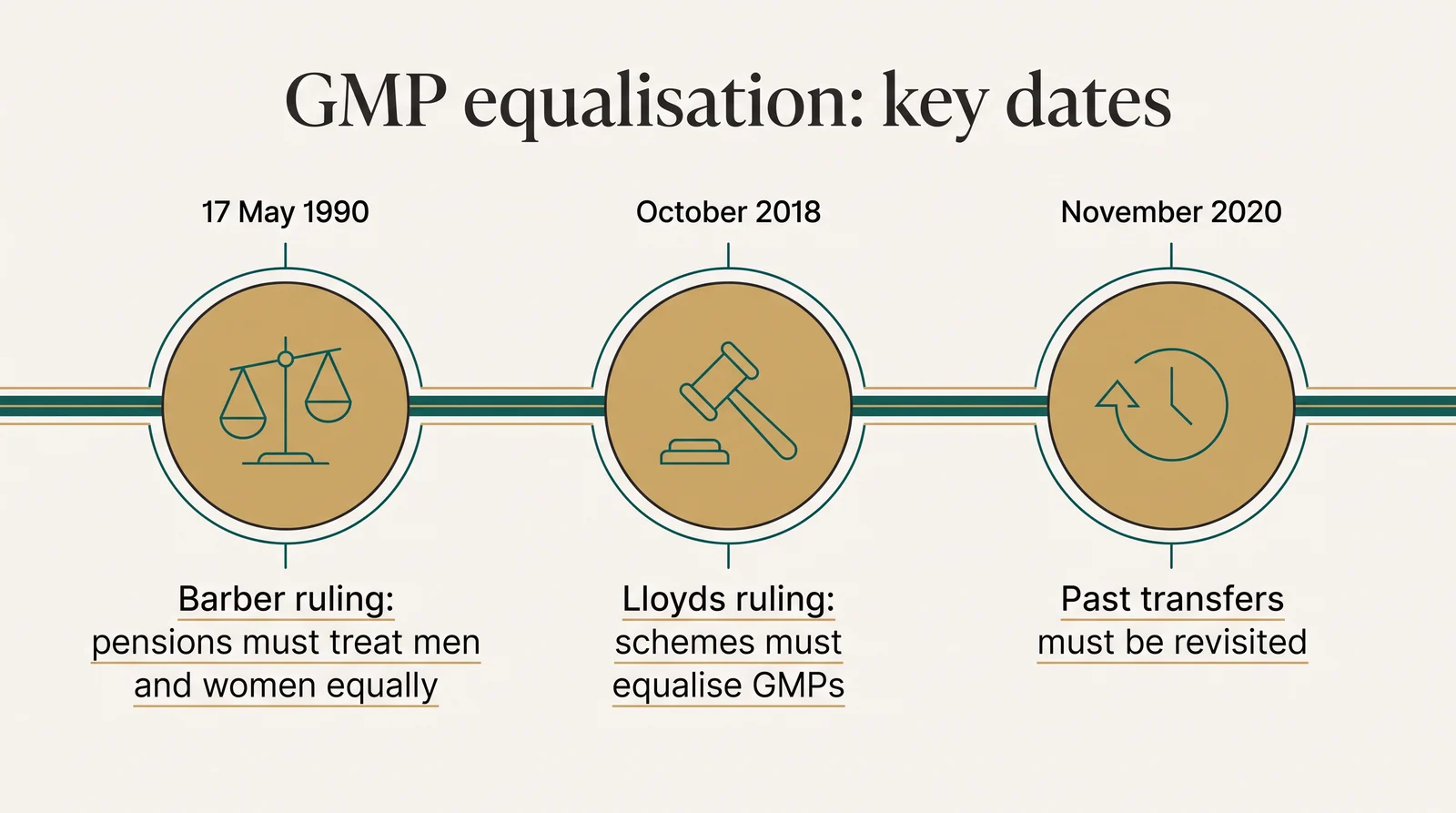
On 17 May 1990, after a long process involving the Employment Tribunal, the Employment Appeal Tribunal and the House of Lords, the European Court of Justice ruled in his favour. Pensions were treated as pay, so benefits built up after that date had to be equal for men and women.
The result was the equalisation of normal retirement ages in occupational schemes.
Why GMPs were left behind
Even after schemes equalised their own retirement ages, the GMP element was not equalised for many years. Working out how to adjust for the different GMP rules was very complex, and the law on exactly what schemes had to do was unclear. In practice, many schemes did not adjust for it, including when calculating transfer values.
The Lloyds Banking Group rulings
The uncertainty was settled by a series of High Court cases involving the Lloyds Banking Group pension schemes.
- October 2018: the High Court ruled that schemes must equalise benefits to remove the inequality caused by GMPs built up between 17 May 1990 and 5 April 1997. The judgment set out acceptable methods, including one that allows schemes to convert GMPs into ordinary scheme benefits.
- November 2020: a follow-up ruling confirmed that trustees must also revisit past individual transfers out, made since 17 May 1990, where the transfer value did not reflect equalised benefits, and pay a top-up to the receiving scheme where needed.
Since then, schemes have been working through the calculations. This is a large exercise: it can involve decades of records, and members who left long ago. Some schemes have finished, while others are still in progress.
What does it mean for you?
If you are still a member of a DB scheme
If you have GMPs built up between 1990 and 1997, your scheme should review whether your benefits need adjusting. For many people, any increase is small. Some people see no change at all, because the comparison may favour their existing benefits. Your scheme will normally write to you if your benefits change.
If you are thinking about a transfer
If you ask for a Cash Equivalent Transfer Value (CETV), it is worth asking the scheme whether GMP equalisation has been reflected in the figure. If the scheme has not finished its equalisation work, ask how it will treat your transfer, and whether a later top-up might be paid. My guide to what is the transfer value of a pension explains how CETVs work. A CETV is guaranteed for three months from its guarantee date.
GMP equalisation is a technical point that rarely changes the bigger picture. The FCA's starting assumption is that a DB transfer is unlikely to be suitable for most people, and if your safeguarded benefits are worth over £30,000, the law requires regulated advice from an FCA-authorised firm with the pension transfer permission before you can transfer.
If you transferred out in the past
If you transferred out of a DB scheme after 17 May 1990 and had GMPs built up between 1990 and 1997, your former scheme may owe a top-up. Any top-up would normally be paid to the scheme you transferred into. Many schemes will contact former members, but if you have moved house or changed provider, they may not be able to find you. It can be worth contacting your former scheme to ask whether it has carried out its GMP equalisation review and whether anything is due.
If you cannot find your old scheme, the government's free Pension Tracing Service can help.
If you are approached about a GMP "refund"
Be careful. Genuine top-ups are arranged by your former scheme and paid into a pension, not to you as cash. Be wary of anyone who contacts you out of the blue offering to recover money from an old pension for a fee, and check the FCA ScamSmart site before acting.
Related reading: cashing in a small defined benefit scheme.
Where to get help
For free, impartial guidance on your pension, including questions about GMPs, contact MoneyHelper. If you are 50 or over with a defined contribution pension, Pension Wise offers free guidance appointments. Your scheme administrator is the best source of information about your own benefits.
If you would like a free chat about how DB transfers and the advice process work, you can get in touch. The chat gives general information, not advice. If you then want regulated advice on a transfer value of £50,000 or more, I can introduce you to an FCA-authorised firm that holds the pension transfer permission. Arthur Browns may receive a fee from the firm we introduce you to if you become their client.
Frequently asked questions
What is GMP equalisation?
It is the requirement for defined benefit schemes to remove the unequal treatment of men and women caused by guaranteed minimum pensions built up between 17 May 1990 and 5 April 1997. The Lloyds Banking Group High Court ruling in October 2018 confirmed schemes must do this.
How does GMP equalisation affect my transfer value?
If your scheme has equalised benefits, your CETV should reflect the equalised figures. If it has not yet finished the work, ask how it will treat your transfer. For most people the effect is small.
What was the Barber ruling and why does it matter?
The Barber ruling (Barber v Guardian Royal Exchange, European Court of Justice, 17 May 1990) established that pension benefits are pay and must be equal for men and women for service after that date. It led to equal retirement ages in occupational schemes and is the starting point for GMP equalisation.
Do I need to do anything if I transferred out in the past?
If you transferred out of a DB scheme after 17 May 1990 and had GMPs built up between 1990 and 1997, your former scheme may need to pay a top-up to the scheme you transferred into, following the November 2020 Lloyds ruling. Your former scheme should contact you, but it is worth asking it directly if you have moved or changed provider.
What is a guaranteed minimum pension (GMP)?
A GMP is the minimum pension that a contracted-out occupational scheme had to provide for members who were contracted out of SERPS between 1978 and 1997. It was meant broadly to replace the SERPS pension the member gave up. See my GMP guide for more.
Will GMP equalisation make a big difference to my pension?
For most people, no. Any adjustment is usually small, and some members see no change. The amount depends on your sex, your age, your GMP built up between 1990 and 1997 and the method your scheme uses.
Important: Arthur Browns Wealth Management Ltd (FCA 825843) does not give defined benefit pension transfer advice. The FCA starts from the position that a transfer is unlikely to be suitable for most people, and a transfer cannot usually be reversed. See Important information.
Related reading

Deferred final salary pensions: what happens when you leave
What a deferred final salary pension is, how it grows until you retire, taking it early or late, tracing a lost one, and the rules if you consider a transfer.
Reviewed 23 October 2026 · 9 min read

Enhanced transfer values (ETVs): what they are and the rules
What an enhanced transfer value is, why employers offer one, the industry code's ban on cash incentives, who pays for advice and questions to ask.
Reviewed 23 October 2026 · 9 min read

How long does a DB pension transfer take?
How long a defined benefit pension transfer takes: the 3-month CETV deadlines, the advice stages, scam checks under the 2021 rules and the 6-month limit.
Reviewed 23 October 2026 · 9 min read