Guide
Should I Invest in Cash in My Pension?


Holding some cash in a defined contribution pension can make sense, for example to cover withdrawals you plan to make in the next year or two, or to reduce risk as you approach retirement. But cash is not without risk: over long periods it has usually grown more slowly than investments, and inflation can erode what it will buy. Most people use cash as one part of a wider mix rather than holding their whole pension in it.
"Cash is king" was the old saying, and then for most of the 2010s it wasn't, because interest rates were close to zero. Since rates rose sharply from 2022, cash has paid a meaningful return again, even though the Bank of England has cut its Bank Rate several times since 2024.
Getting a good rate on cash inside a pension isn't always straightforward. This article explains how cash can be used as part of an overall pension strategy, the main ways to hold it, and the risks to weigh up.
This applies to defined contribution pensions, such as SIPPs, personal pensions and workplace DC schemes. If you have a defined benefit (final salary) pension, the scheme invests the money and pays you a set income, so there is no cash choice to make within it.
Key takeaways
- Cash in a pension can provide a steady return with low volatility, but it is not risk-free. Inflation can mean its real value falls, rates can change, and protection limits apply if a bank fails.
- Interest paid on pension cash accounts varies widely between providers, and some pay much less than the Bank Rate.
- Fixed-term deposits and fixed-term annuities can lock in a rate for a set period, but your money is usually tied up until the end.
- Money market funds are a lower-risk investment that tends to track short-term interest rates, but they are investments, not bank deposits, so they can fall in value and charges apply.
- Over the long term, holding a large part of your pension in cash risks lower growth than a diversified mix of investments.
Interest on pension cash accounts
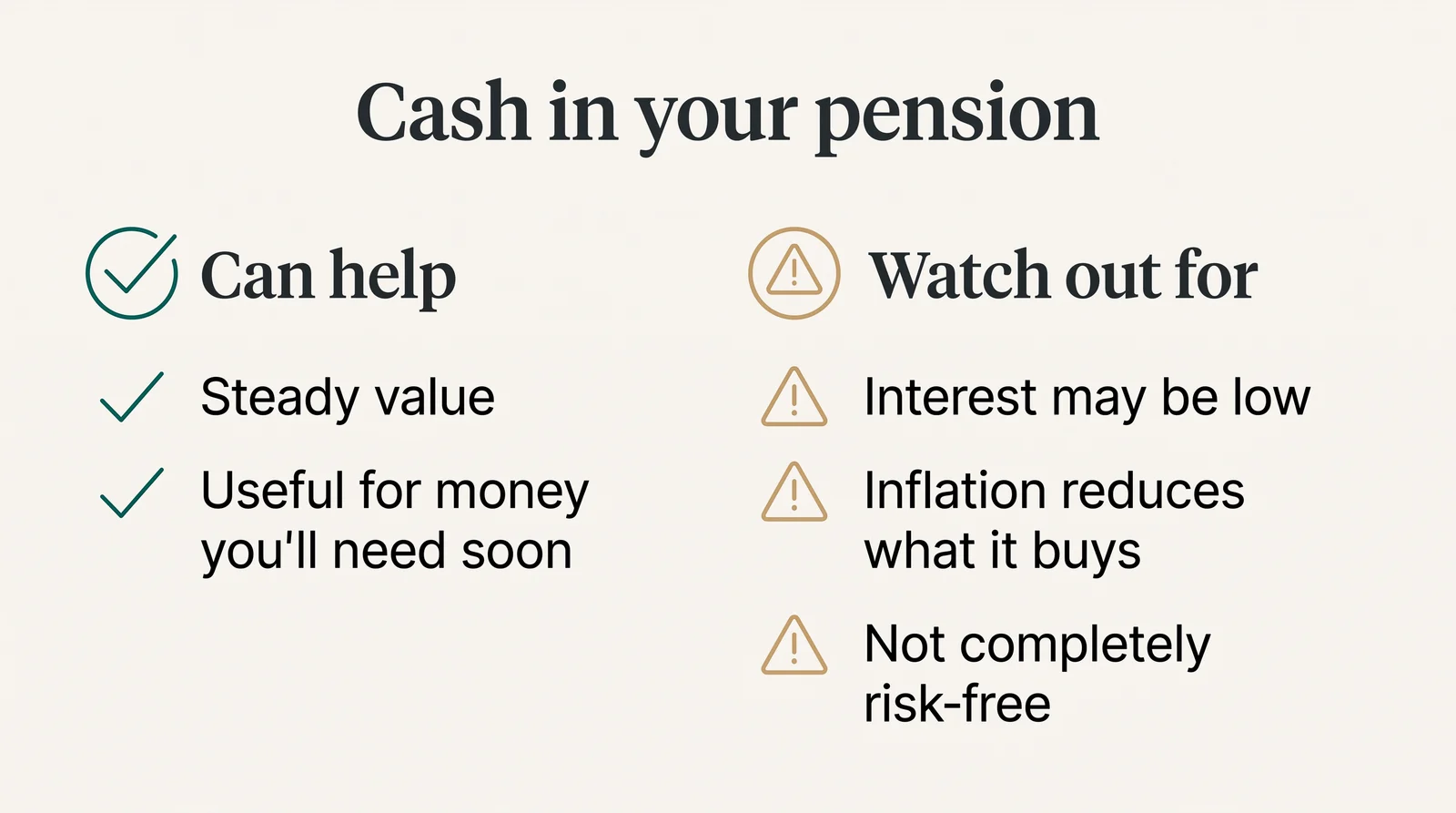
As with many high street banks, pension providers have often been slow to pass higher interest rates on to cash held in pension accounts.
The cash account in a self-invested personal pension (SIPP) is not usually designed to hold large sums for long periods. It mainly acts as a holding account: money waiting to be invested, money to pay charges and withdrawals, and money moving in or out through transfers.
When interest rates rose, many investors realised that holding some cash could be a sensible part of an overall strategy. It's still worth remembering that, historically, holding cash for long periods has usually produced lower returns than investing in a diversified portfolio.
Rates on pension cash accounts differ a great deal between providers. Some pay a tiered rate that rises with the balance, some pay a flat rate, and some pay very little at all. Rates also change frequently, often soon after the Bank Rate moves. If you hold a meaningful amount of cash in your pension, it's worth:
- checking the rate your provider currently pays on its website or your statement
- checking whether the rate depends on how much you hold
- comparing it with what is available through the provider's other cash options, such as a cash fund or a fixed-term deposit
- checking whether the provider keeps part of the interest earned on your cash, which some do
How safe is cash in a pension?
Pension cash is usually held by the provider in accounts with one or more banks. The Financial Services Compensation Scheme (FSCS) protects deposits if a UK bank fails. The deposit protection limit rose from £85,000 to £120,000 per person, per banking licence, on 1 December 2025.
How that protection applies to cash inside a pension depends on how your provider holds it, so check the provider's own explanation. Some providers spread cash across several banks to reduce the risk. If you have other savings with the same bank, they may share the same limit.
Fixed-term deposits
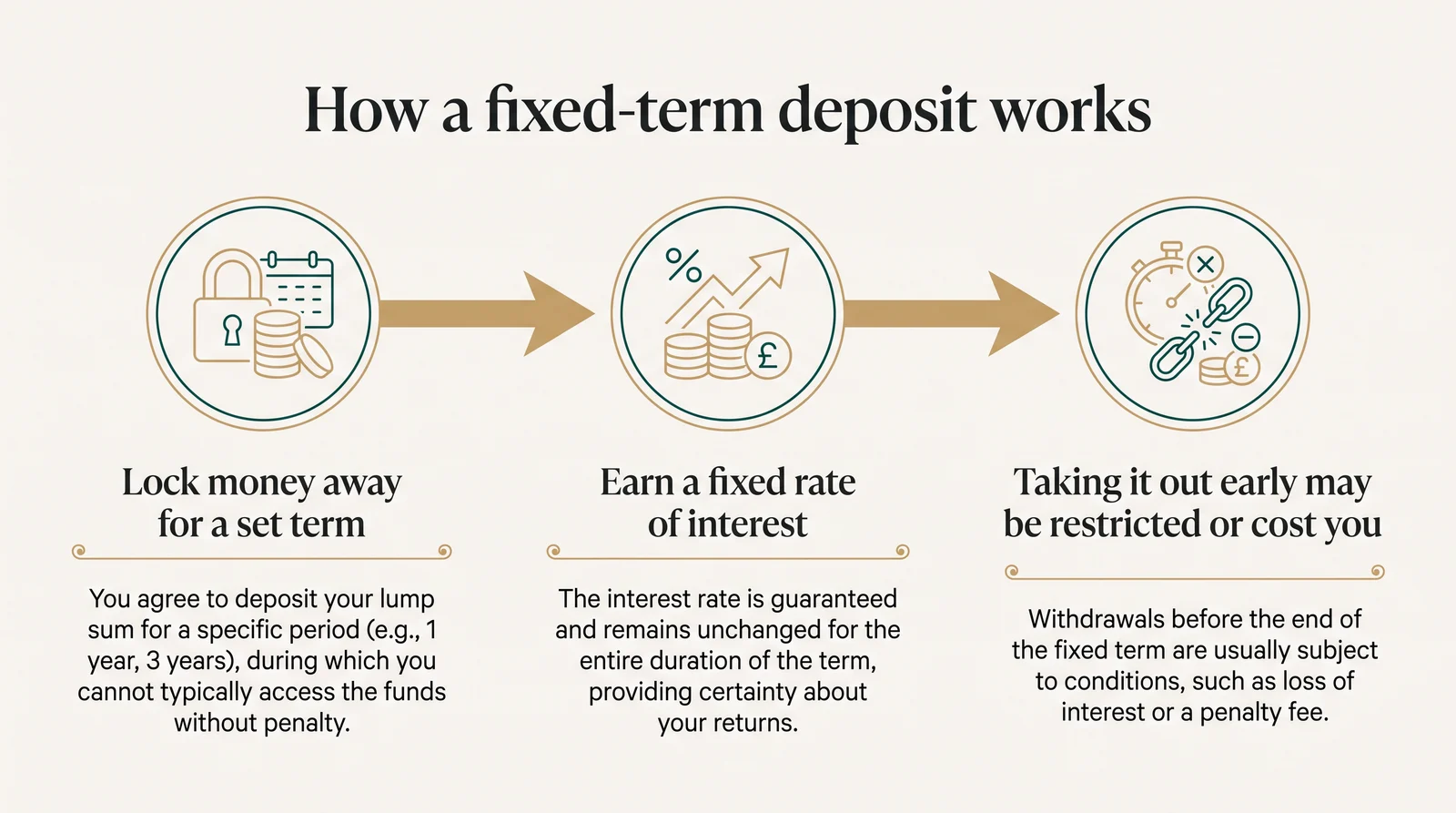
Another option is to fix a rate for a longer period. In the same way that you can put savings into a fixed-rate bond with a bank, you can lock pension cash into a fixed-term deposit within a SIPP. They are less widely known than they might be, partly because relatively few providers offer or promote them.
For much of the last decade, rates on fixed-term deposits were so low that they gave no real return after inflation. Higher interest rates have made them more interesting again.
They tend to work like this:
- a SIPP or platform provider gives access to a range of banks offering fixed-term deposits within the pension
- some providers offer a "cash panel" or cash hub that makes them easy to choose, while others only offer them on request
- terms are typically from a few months up to five years, and the rate is fixed for the term
Points to check before you commit:
- Access. Interest is often paid at the end of the term, and unlike some savings accounts you usually cannot get your money out early. Be sure you won't need it during the term, including for planned pension withdrawals.
- Rates. Rates vary between banks and change often. Longer terms don't always pay more.
- Protection. The deposit is with the bank, so check FSCS protection and how it applies to the bank you choose, especially if it is not a UK-authorised bank.
- Charges. Some providers charge to arrange a deposit or take a margin.
Fixed-term annuities ("guaranteed drawdown")
There is another way to lock in today's rates while keeping more control than a lifetime annuity gives. It is sometimes called guaranteed drawdown, but its proper name is a fixed-term annuity.
It sits halfway between a lifetime annuity and drawdown:
- you use some or all of your pension to buy a plan for a fixed term, often anywhere from a few years to a couple of decades
- you choose whether to take an income during the term, and how much
- at the end of the term you receive a guaranteed maturity value, which you can use to buy another annuity, move into drawdown or, depending on the plan, take in other ways
Because the maturity value is set at the start, a fixed-term annuity removes investment risk for the term. The trade-offs are that you are locked in, the income is usually taxable, inflation can still reduce what the money will buy, and the rates offered depend on interest rates when you buy. Quotes vary between providers and change frequently, so compare them through a broker or adviser, or use the MoneyHelper annuity comparison tool.
Money market funds
If locking your money away for a period doesn't suit your access needs, money market funds are another option. They invest in very short-term lending to governments, banks and large companies, such as treasury bills, certificates of deposit and commercial paper. Their returns tend to follow the Bank Rate fairly closely, and you can usually buy and sell them on any working day.
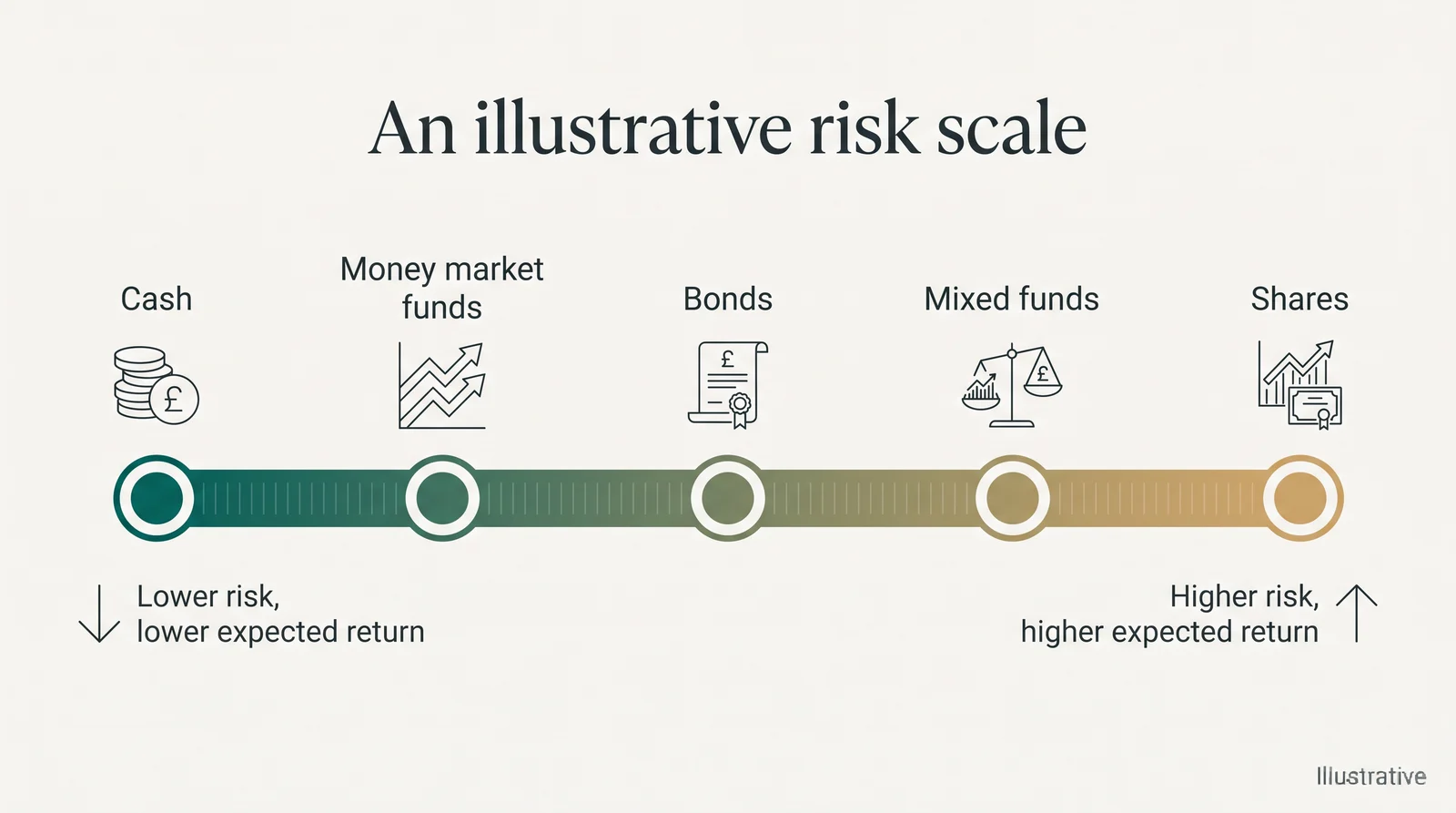
On most risk scales, money market funds sit at the lower end, below bonds and shares. But it's important to understand what they are and are not:
- They are investments, not deposits. Their value can fall, although large falls are rare.
- They are not covered by FSCS deposit protection in the same way as a bank account.
- Charges matter. Fund charges and any platform fees come off the return, and with low-risk funds the charges can take a big share of it.
- Returns change. When interest rates fall, money market returns usually fall soon after.
Most pension platforms offer several money market or "cash" funds. Look at the fund factsheet for the charges, what the fund invests in and its past returns, remembering that past performance is not a guide to the future.
Cash and inflation
The biggest long-term risk with cash is inflation. If prices rise faster than the interest you earn, your money buys less each year even though the number on your statement goes up. Over a retirement that could last 25 or 30 years, that matters a great deal.
That's why cash is usually treated as one part of a pension strategy rather than the whole of it. Common uses include:
- holding one to two years of planned withdrawals in cash, so you're not forced to sell investments after a fall
- reducing risk gradually as you approach the date you plan to buy an annuity or take a lump sum
- parking money briefly during a transfer or while deciding how to invest
Getting help
Investment decisions within a pension depend on your circumstances, including when you need the money, what other income you have and how much risk you are comfortable with. Free, impartial guidance is available from MoneyHelper, and if you're 50 or over you can book a free Pension Wise appointment about your options for DC pensions. A regulated financial adviser can give personal advice.
Be wary of anyone promising unusually high "guaranteed" returns on your pension. It is a common sign of a scam, so check the FCA's ScamSmart pages before you do anything.
If you have a defined benefit pension and are thinking about whether to transfer it, remember that a DB pension pays a guaranteed income without you choosing investments at all. The FCA's starting assumption is that a transfer is unlikely to be suitable for most people. You can book a free, no-obligation chat about how DB transfers and the advice process work. It's general information, not advice.
Frequently asked questions
What other investment options can I consider for my pension apart from cash?
Most pensions offer a range of funds investing in shares, bonds, property and other assets, as well as mixed funds that combine them. Spreading your money across different types of investment can help manage risk. It's important to understand each option before deciding how to invest, and to take advice if you're unsure.
How will inflation affect cash in my pension?
Inflation can erode the value of cash over time. If inflation is higher than the interest you earn, your savings lose buying power in real terms even though the balance rises. It's important to factor this in when planning how your pension is invested, especially over a long retirement.
Is it sensible to hold my entire pension in cash?
Putting all your pension savings into cash may feel reassuring, especially when rates are reasonable. But diversification is generally considered important, interest rates can fall, and inflation can erode cash over the long term. Holding a mix of assets that suits when you need the money may help manage risk. It's worth getting guidance or advice before making a big change.
Is cash in a pension risk-free?
No. Cash has low volatility, but it carries inflation risk, the risk that rates fall, and the small risk of a bank failing, where protection limits apply. Money market funds are investments and can fall in value. Fixed-term deposits and annuities tie your money up for the term.
What is the difference between cash in a pension and money in a savings account?
Cash in a pension benefits from tax relief on contributions and from growing free of income tax and capital gains tax within the pension. But you can only take money from a pension from the normal minimum pension age, which is 55 now and rises to 57 on 6 April 2028 unless you have a protected pension age. Withdrawals beyond the tax-free part are taxed as income. A savings account gives easier access but no pension tax relief.
Important: Arthur Browns Wealth Management Ltd (FCA 825843) does not give defined benefit pension transfer advice. The FCA starts from the position that a transfer is unlikely to be suitable for most people, and a transfer cannot usually be reversed. See Important information.
Related reading

Deferred final salary pensions: what happens when you leave
What a deferred final salary pension is, how it grows until you retire, taking it early or late, tracing a lost one, and the rules if you consider a transfer.
Reviewed 23 October 2026 · 9 min read

Enhanced transfer values (ETVs): what they are and the rules
What an enhanced transfer value is, why employers offer one, the industry code's ban on cash incentives, who pays for advice and questions to ask.
Reviewed 23 October 2026 · 9 min read

How long does a DB pension transfer take?
How long a defined benefit pension transfer takes: the 3-month CETV deadlines, the advice stages, scam checks under the 2021 rules and the 6-month limit.
Reviewed 23 October 2026 · 9 min read