Guide
What is a Pension Transfer Specialist?


A pension transfer specialist is a qualified financial adviser who holds extra, FCA-recognised qualifications to give or check advice on transferring pensions with safeguarded benefits, such as final salary pensions. If your safeguarded benefits are worth more than £30,000, the law requires you to take advice from an FCA-authorised firm with the pension transfer permission before you can transfer, and that advice must be given or checked by a pension transfer specialist.
About this website. Despite its name, The Pension Transfer Specialist website does not give pension transfer advice, and Arthur Browns does not hold the pension transfer permission. Phil offers a free, no-obligation chat with general information about how DB transfers and the advice process work. If you then want regulated advice, he can introduce you to an FCA-authorised firm that holds the pension transfer permission. Arthur Browns may receive a fee from the firm we introduce you to if you become their client. See how it works and our important information.
What does a pension transfer specialist do?
A pension transfer specialist is a qualified adviser in the UK who has taken additional qualifications to advise on pensions with safeguarded benefits.
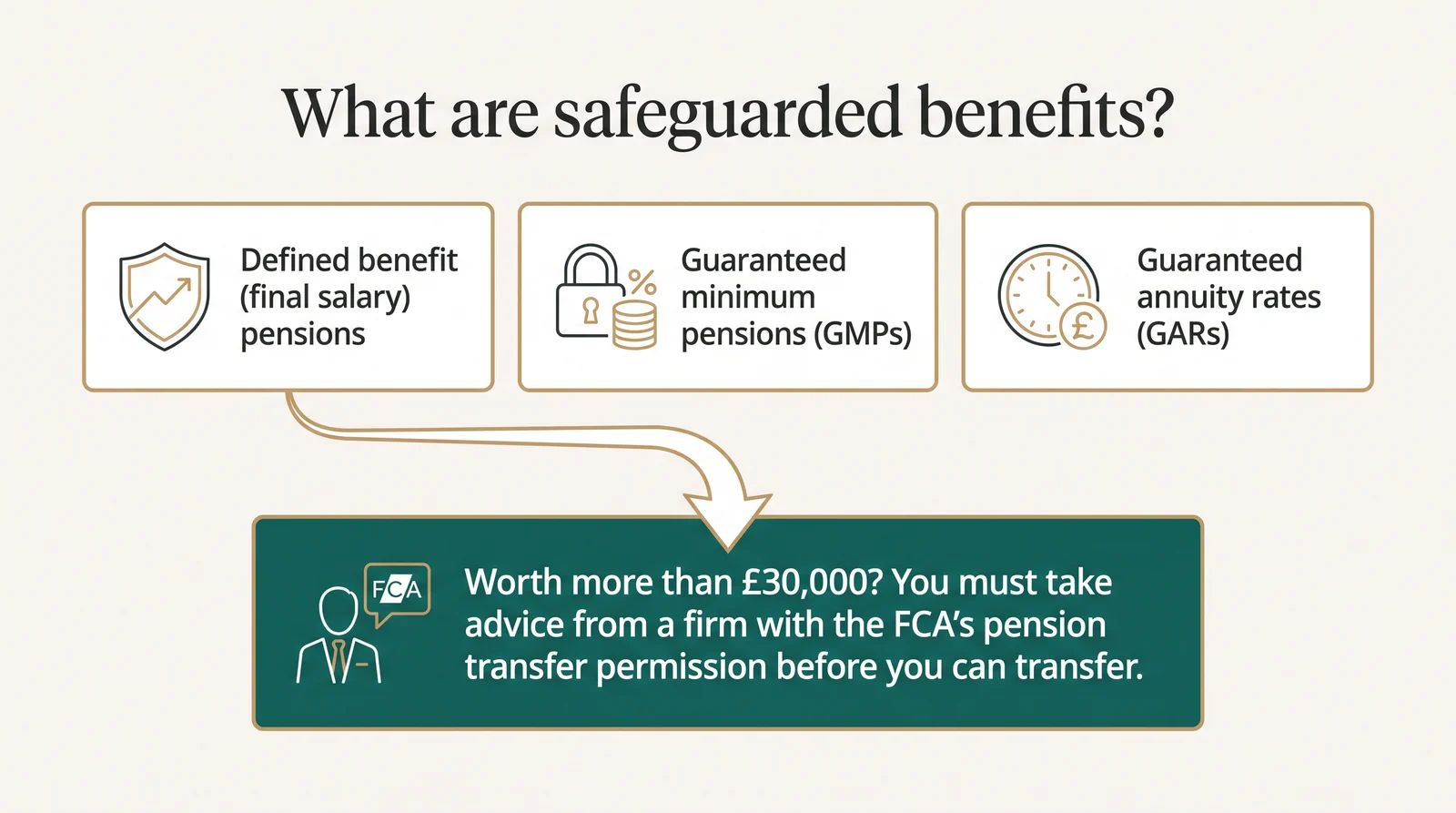
In essence, pensions that promise to pay a certain level of benefit can only be advised on by an adviser with the right qualifications, working for a firm with the right permission. The exception is where the benefits are worth £30,000 or less. In that case, the member can usually choose to transfer without advice, although taking advice or guidance is still sensible.
The government explains the rules in its guidance on pension benefits with a guarantee and the advice requirement.
Which pensions need specialist advice?
The Pension Schemes Act 2015 made advice compulsory for transfers out of certain schemes with protected benefits, from April 2015.
These protected, or safeguarded, benefits are any benefits other than money purchase or cash balance benefits. They include:
- Guaranteed pensions, including pensions with guaranteed annuity rates (GARs).
- Defined benefit or final salary pensions.
- Guaranteed minimum pensions (GMPs).
- The defined benefit part of hybrid schemes.
If a member of one of these schemes is thinking about transferring to a more flexible pension, and the safeguarded benefits are worth more than £30,000, advice from a firm with the pension transfer permission is required. These schemes can be complex and need detailed analysis alongside a careful look at the member's personal circumstances.
Advice is required whether the member wants to transfer the whole pension or part of it, or to convert the benefits so that they can take a flexible income or cash lump sum.
Not every DB pension can be transferred to a defined contribution pension at all. Members of unfunded public-sector schemes, such as the NHS, Teachers', Police, Firefighters', Civil Service and Armed Forces schemes, have not been able to transfer to a defined contribution pension since April 2015. The Local Government Pension Scheme is funded and can. See our guide to public-sector pensions.
What qualifications and permissions are needed?
A pension transfer specialist must hold an FCA-recognised pension transfer qualification, such as the CII's AF7 (Pension Transfers) or the LIBF Level 6 Award in Pension Transfers, alongside the qualifications needed to be a financial adviser. Since October 2020, they must also hold an investment advice qualification.
The firm they work for must be authorised by the FCA with permission to advise on pension transfers. You can check both the firm and the individual on the FCA Register.
What does the analysis involve?
A pension transfer specialist has to look at a wide range of factors before any advice is given.
One part is comparing the guaranteed benefits with the transfer value on offer. There is no single way of setting transfer values, and schemes value benefits differently. Some schemes might offer a transfer value of 20 times the yearly pension, and others much more. For example:
- Person A is offered a pension of £20,000 a year at normal retirement age, or a transfer value of £400,000 (20 times).
- Person B is offered a pension of £20,000 a year at normal retirement age, or a transfer value of £1,000,000 (50 times).
These figures are for illustration only. A higher multiple can look more attractive, but it does not on its own mean a transfer is suitable. Under FCA rules, the adviser must carry out an appropriate pension transfer analysis (APTA), which includes a transfer value comparator (TVC) showing what it might cost to buy the same benefits on the open market. Read more about transfer values.
The comparison is only part of the picture. The adviser also needs to understand, for example:
- Whether the member is married or in a civil partnership.
- Whether they have dependent children.
- Their current and future income.
- Their current and future spending.
- Any other guaranteed pension income.
- Any other defined contribution pensions.
- Other savings, both cash and investments.
- Other assets, such as property.
- Their health.
- The strength of the scheme and its sponsoring employer.
- Any debts, mortgages or loans.
On top of all this, and most importantly, the adviser needs to understand the member's needs and objectives.
Flexibility is one of the most common reasons people give for considering a transfer, but on its own it is too broad. Why is flexibility needed, when, and how much? The adviser has to pin this down. Without it, they do not have a full picture of the member's circumstances and cannot give suitable advice.
The FCA's starting assumption is that a transfer is unlikely to be suitable for most people. In short, for a transfer to be recommended, the adviser has to be able to show, based on evidence, that it is in the member's best interests, and that their needs and objectives cannot reasonably be met by staying in the existing scheme. This has to be documented and set against their circumstances.
How does the advice process work?
Advice is only given once the member and the firm have agreed to go ahead and the costs have been explained. It can take the form of abridged advice or full advice.
Abridged advice
Some firms offer abridged advice. It is a shorter first stage of advice that can only conclude "don't transfer" or that it is unclear whether a transfer is suitable and full advice is needed. It cannot recommend a transfer. Read more in our guide to abridged advice.
Full advice
If full advice is agreed, the firm must tell you the full cost of its services up front.
The outcome of full advice is a recommendation either:
- to transfer the pension, or
- to stay in the existing scheme.
Since 1 October 2020, firms have generally been banned from contingent charging for DB transfer advice. That means the fee must be the same whatever the recommendation, except in limited cases of serious ill health or serious financial hardship.
The adviser provides a suitability report setting out the member's circumstances, an analysis of the safeguarded benefits and the reasons a transfer is or is not considered suitable.
If a transfer is recommended, the advice must also take into account where the money would go, including the receiving pension and how it would be invested. Under FCA rules, advisers must consider the proposed destination as part of the advice, so it is unusual for a firm to advise on a transfer and leave the member to choose their own investments without advice.
Other limits
Advice in this area is governed by FCA rules and, in practice, by the terms of the advising firm's professional indemnity insurance. Some firms limit the types of case they take on as a result.
In summary
The law requires advice from a firm with the pension transfer permission, given or checked by a pension transfer specialist, before most safeguarded benefits worth more than £30,000 can be transferred. The specialist looks at the member's circumstances under strict regulatory rules, and for most people the likely outcome is to keep the guaranteed pension.
For free, impartial guidance, contact MoneyHelper. Be wary of anyone who contacts you out of the blue about your pension, and check the FCA ScamSmart site before dealing with any firm.
If you would like to understand how DB transfers and the advice process work before speaking to a firm, you can book a free chat about how the process works. It is general information, not advice.
Frequently asked questions
What is a pension transfer specialist?
A pension transfer specialist is a financial adviser who holds FCA-recognised qualifications to give or check advice on transferring safeguarded pension benefits, including defined benefit (final salary) pensions, guaranteed annuity rates and guaranteed minimum pensions. Where safeguarded benefits are worth more than £30,000, the advice must come from a firm with the pension transfer permission and be given or checked by a pension transfer specialist.
Do I need a pension transfer specialist to transfer my defined benefit pension?
Yes, if your safeguarded benefits are worth more than £30,000. Under the Pension Schemes Act 2015, you must take advice from an FCA-authorised firm with the pension transfer permission before transferring. This applies whether you want to transfer all or part of the benefits, or to take a flexible income or cash lump sum.
What qualifications does a pension transfer specialist need?
They must hold an FCA-recognised pension transfer qualification, such as the CII's AF7 or the LIBF Level 6 Award in Pension Transfers, as well as the qualifications needed to be a financial adviser. Since October 2020 they must also hold an investment advice qualification. Their firm must be authorised by the FCA to advise on pension transfers.
What factors does a pension transfer specialist consider?
They look at your income needs and spending, other guaranteed income, other savings and assets, your health and family, the strength of the existing scheme, any debts and, crucially, your specific needs and objectives. They also compare the guaranteed benefits with the transfer value, using a transfer value comparator, before any recommendation is made.
What is the difference between abridged advice and full advice?
Abridged advice is a shorter first stage that can only conclude "don't transfer" or that full advice is needed. It cannot recommend a transfer. Full advice is a complete assessment of your circumstances and ends in a recommendation either to transfer or to stay in the scheme. Both are regulated advice, and the costs must be explained up front.
This article is general information, not financial advice.
Important: Arthur Browns Wealth Management Ltd (FCA 825843) does not give defined benefit pension transfer advice. The FCA starts from the position that a transfer is unlikely to be suitable for most people, and a transfer cannot usually be reversed. See Important information.
Related reading

Deferred final salary pensions: what happens when you leave
What a deferred final salary pension is, how it grows until you retire, taking it early or late, tracing a lost one, and the rules if you consider a transfer.
Reviewed 23 October 2026 · 9 min read

Enhanced transfer values (ETVs): what they are and the rules
What an enhanced transfer value is, why employers offer one, the industry code's ban on cash incentives, who pays for advice and questions to ask.
Reviewed 23 October 2026 · 9 min read

How long does a DB pension transfer take?
How long a defined benefit pension transfer takes: the 3-month CETV deadlines, the advice stages, scam checks under the 2021 rules and the 6-month limit.
Reviewed 23 October 2026 · 9 min read