Guide
How Do Gilt Yields Affect Defined Benefit Transfer Values


Gilt yields have a big effect on defined benefit transfer values. When gilt yields rise, schemes assume they need less money today to pay your future pension, so cash equivalent transfer values (CETVs) usually fall. When yields fall, CETVs usually rise. That makes CETVs move with the markets, but it does not change the value of the guaranteed income you would be giving up.
Why gilt yields matter
If you are thinking about a defined benefit pension transfer, it helps to understand the significant effect that gilt yields have on transfer values. A rise in gilt yields can lead to a substantial fall in the transfer value your scheme quotes.
Gilt yields are one of the key factors in working out the cost of providing a guaranteed income from a defined benefit pension. A gilt is a loan to the UK government, and the yield is the return an investor gets from it. Scheme actuaries use gilt yields, along with other assumptions, to decide how much money needs to be set aside today to pay your pension in future. When yields rise, the money needed today falls, so the transfer value falls too. This inverse relationship is central to understanding why CETVs change.
Here is a simple way to picture it. Imagine a pension of £10,000 a year. If the scheme's assumptions mean it needs £250,000 today to provide that income, and yields then rise so that it needs only £150,000, the CETV would fall to reflect that. The pension itself, £10,000 a year with its increases and spouse's benefits, has not changed at all. These figures are for illustration only.
Changes in the economic environment, inflation expectations and wider market conditions can all move gilt yields, sometimes sharply. That can lead to sudden changes in transfer values. But a transfer decision should be based on your needs and circumstances, not on trying to time the market. The FCA's starting assumption is that a transfer is unlikely to be suitable for most people, whatever the CETV.
The effect of rising gilt yields
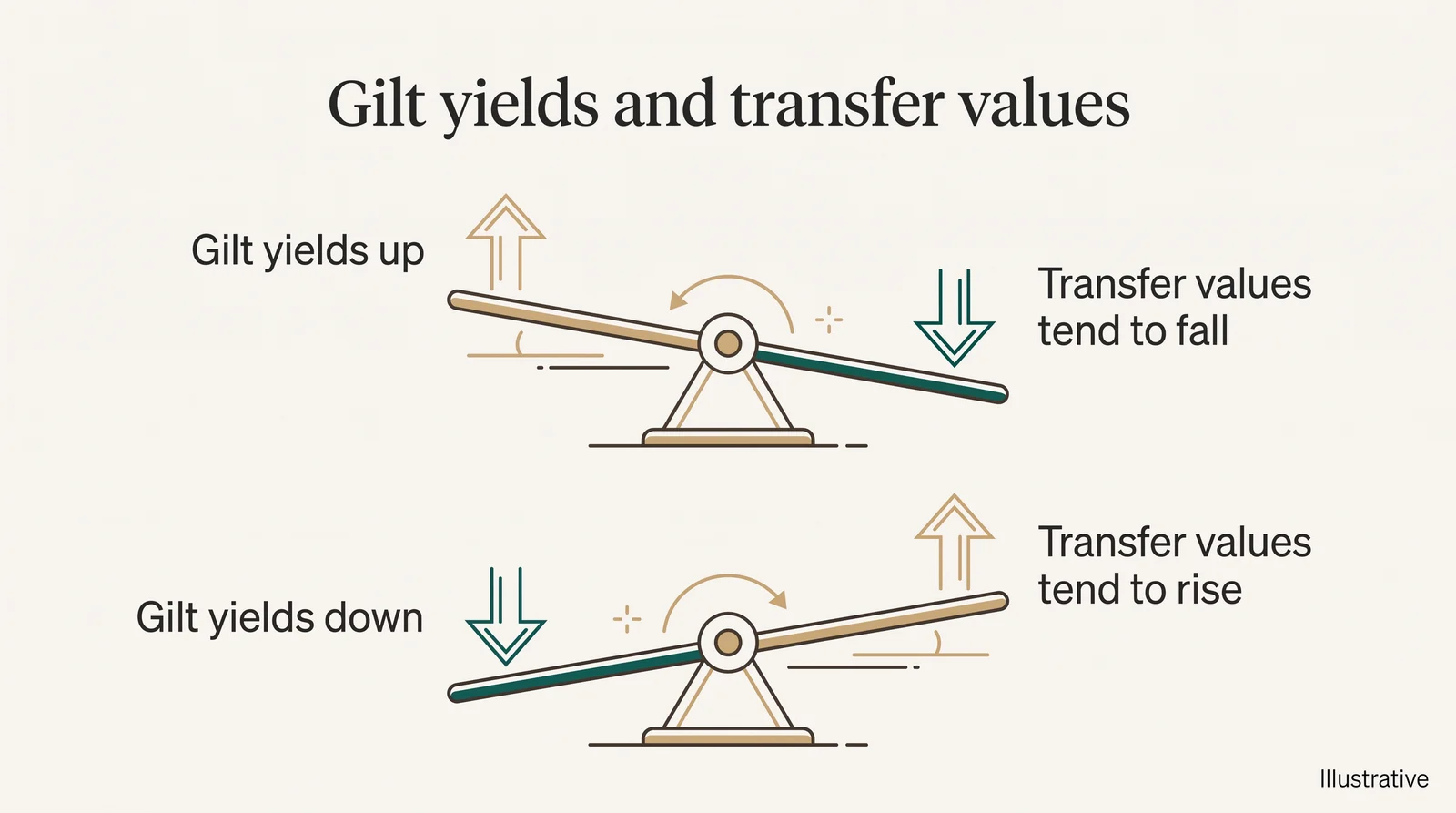
Rising gilt yields and defined benefit transfer values
Gilt yields were at historically low levels in 2020 and 2021, which pushed transfer values to unusually high levels. When yields rose sharply during 2022, many DB members saw a significant fall in the transfer values they were quoted, in some cases by a large proportion of the earlier figure.
Higher gilt yields reduce the value placed on a scheme's liabilities, which usually improves its funding position and lowers transfer values.
Because a scheme expects higher returns on safe assets, the money it needs to pay a member's pension falls, and transfer values fall with it.
Rising yields also reduced the value of compensation paid to people who had received unsuitable transfer advice in the past, because redress calculations also depend on gilt yields. Research reported by Professional Pensions in 2022 found that this compensation had fallen sharply as yields rose.
Lower transfer values were followed by a fall in transfer activity, as members became more cautious about making an irreversible decision. It underlines the importance of good information and, where a transfer is being considered, regulated advice.
The effect on pension schemes
The financial health of a defined benefit scheme is closely linked to gilt yields. A rise in yields generally improves a scheme's funding position, because the value placed on its future pension payments falls.
But a sharp rise in gilt yields can also cause problems for schemes using liability-driven investment (LDI). These strategies use borrowing and derivatives to match the scheme's assets more closely to its liabilities, and they become strained when yields rise too far, too fast.
Schemes may then need to provide extra collateral to their LDI funds quickly, which can lead to forced selling of gilts. That selling can push gilt prices down further and make the problem worse.
The result can be losses on the value of the scheme's investments and large calls for collateral that require schemes to sell assets. The UK gilt market turmoil in autumn 2022 exposed these weaknesses, and the Bank of England stepped in with a temporary gilt-buying programme to restore order. Since then, regulators including The Pensions Regulator have set out expectations for schemes to hold more liquidity and manage LDI risks more carefully.
Schemes with large gilt holdings, particularly those using LDI, need to manage their exposures carefully. A sudden spike in yields can change their funding position quickly.
Having enough liquidity and a well-thought-out risk management approach helps schemes withstand sharp market moves and stay financially stable.
Insurers, which hold gilts to back annuities, generally came through the 2022 turmoil better. The Association of British Insurers explained why insurers weathered the gilt yields rise.
Understanding how gilt yields and scheme funding interact is important for trustees, and it also helps members understand why their CETV can change from one statement to the next.
Recent trends in defined benefit transfer values
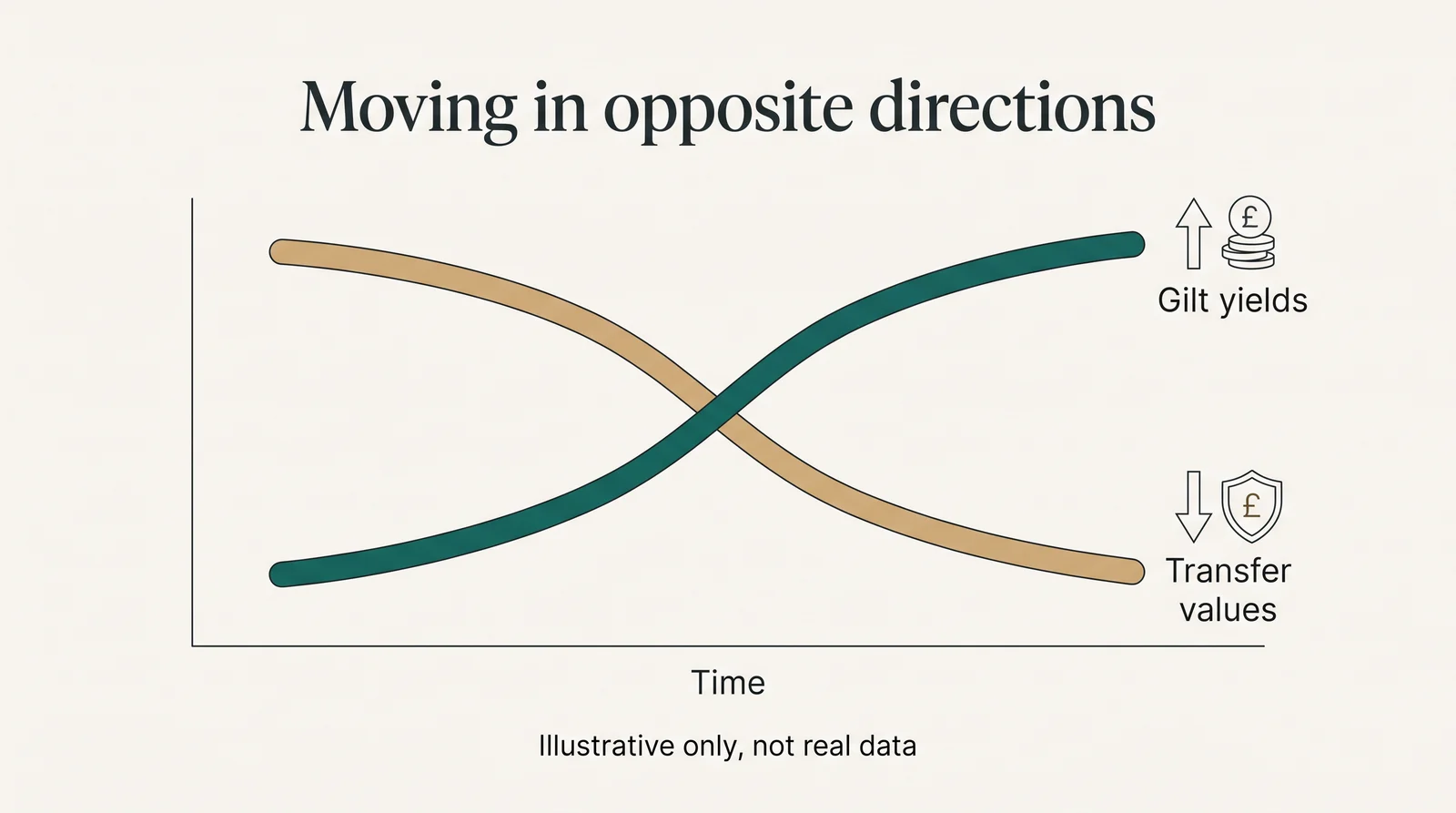
The UK gilt market has moved significantly in recent years, with a big effect on defined benefit transfer values. Transfer values fell sharply during 2022 as gilt yields rose, with a particularly sharp fall in the autumn.
Higher gilt yields have generally improved the funding positions of DB schemes, but they have reduced transfer values. Over short periods, transfer values can change noticeably in a matter of weeks.
Since 2022, gilt yields have stayed well above the very low levels of 2020 and 2021, so CETVs have generally been lower than at their peak. Higher yields have also made annuity rates more attractive, which is worth bearing in mind if you have defined contribution savings too.
Transfer activity has settled at a much lower level than the peak years. Pension scams remain a real risk, so take care with anyone who contacts you about your pension. Check the FCA ScamSmart site before you deal with anyone.
Many schemes are also preparing for buyout with an insurer, which can affect the options available to members. The abolition of the Lifetime Allowance in April 2024, replaced by the Lump Sum Allowance and the Lump Sum and Death Benefit Allowance, and the inheritance tax changes due from April 2027 have also changed the wider picture. It is worth keeping up to date with rule changes that affect DB pensions.
A CETV is usually guaranteed for three months from its guarantee date, and you are normally entitled to one free statement every 12 months. Our guide to transfer values explains more, and our article on what affects DB transfer values covers the other factors involved.
Why advice matters in transfers
Pension transfers are complex decisions, and the factors that drive transfer values are only part of the picture. If your safeguarded benefits are worth more than £30,000, the law requires you to take regulated advice from an FCA-authorised adviser whose firm holds the pension transfer permission before you can transfer.
A regulated adviser looks at your whole financial situation and retirement goals, explains the possible outcomes and risks, and helps you reach an informed decision. That matters because a pension transfer cannot be undone.
A higher or lower CETV changes the numbers, but the guaranteed income you would give up stays the same. A good adviser will focus on whether a transfer is in your best interests, not on whether now is a good time to cash in.
The Financial Conduct Authority stresses the importance of advice on transfers from defined benefit to defined contribution pensions. You can read the FCA's consumer guidance on its pension transfer page. For free, impartial guidance, contact MoneyHelper.
If you would like to understand how DB transfers and the advice process work, you can book a free chat about how the process works. It is general information, not advice.
Frequently asked questions
What are gilt yields and how do they relate to defined benefit pensions?
Gilt yields are the returns on UK government bonds (gilts). Defined benefit schemes use them, alongside other assumptions, to work out how much money they need today to pay future pensions. When gilt yields are higher, the money needed falls, which lowers cash equivalent transfer values (CETVs).
Why do rising gilt yields reduce defined benefit transfer values?
When gilt yields rise, a scheme can expect higher returns from safe assets, so it needs less money today to pay future pensions. That reduces the value placed on its liabilities and the CETV it offers members. The pension you would receive by staying in the scheme does not change.
How much have defined benefit transfer values fallen in recent years?
Transfer values fell sharply in 2022 as gilt yields rose, and they have generally stayed below their 2020 and 2021 peak since. How much any one member's CETV changed depends on the scheme, the member's age and the benefits involved. Ask your scheme for a current quotation.
Should I transfer my defined benefit pension when gilt yields are high?
The level of gilt yields should not be the reason for a transfer decision. A lower or higher CETV does not change what you would give up: a guaranteed income for life. The FCA's starting assumption is that a transfer is unlikely to be suitable for most people. If your safeguarded benefits are worth more than £30,000, you must take regulated advice from an FCA-authorised adviser with the pension transfer permission before you can transfer.
What is a cash equivalent transfer value (CETV) and how is it calculated?
A CETV is the lump sum your scheme offers to pay into another pension in exchange for giving up your defined benefit rights. The trustees calculate it using actuarial assumptions about your expected pension, your age, life expectancy, gilt yields and the scheme's investments. It broadly represents the amount the scheme thinks it needs to invest today to provide your future pension.
Do I need financial advice before transferring my defined benefit pension?
Yes, if your safeguarded benefits are worth more than £30,000. UK law requires you to take regulated advice from an FCA-authorised adviser with the pension transfer permission before you can transfer. This is because a DB transfer is generally irreversible and has serious long-term consequences.
This article is general information, not financial advice.
Important: Arthur Browns Wealth Management Ltd (FCA 825843) does not give defined benefit pension transfer advice. The FCA starts from the position that a transfer is unlikely to be suitable for most people, and a transfer cannot usually be reversed. See Important information.
Related reading

Deferred final salary pensions: what happens when you leave
What a deferred final salary pension is, how it grows until you retire, taking it early or late, tracing a lost one, and the rules if you consider a transfer.
Reviewed 23 October 2026 · 9 min read

Enhanced transfer values (ETVs): what they are and the rules
What an enhanced transfer value is, why employers offer one, the industry code's ban on cash incentives, who pays for advice and questions to ask.
Reviewed 23 October 2026 · 9 min read

How long does a DB pension transfer take?
How long a defined benefit pension transfer takes: the 3-month CETV deadlines, the advice stages, scam checks under the 2021 rules and the 6-month limit.
Reviewed 23 October 2026 · 9 min read