Guide
Pension Transfer Checklist: Everything You Need to Know Before Transferring Your Pension


Before transferring a pension, especially a defined benefit (final salary) pension, you need to know exactly what you would be giving up, have the right documents, and take regulated advice from an FCA-authorised firm with the pension transfer permission. That advice is a legal requirement if your safeguarded benefits are worth over £30,000. This checklist walks through each stage so you know what to expect and what to ask.
Transferring a DB pension is one of the biggest financial decisions you can make. The rules are complex and a transfer usually cannot be undone. The FCA's starting assumption is that a transfer is unlikely to be suitable for most people. Nothing in this checklist will tell you whether a transfer is right for you, and it is not meant to. It is here to help you understand the process, gather what you need and ask good questions.
Quick navigation
- Part 1: Before you start: know what you have
- Part 2: What a regulated adviser will want to understand about you
- Part 3: Finding an FCA-authorised firm with the pension transfer permission
- Part 4: The advice process: what to expect
- Part 5: Documents you will need
- Part 6: If you do transfer: what to check afterwards
- Part 7: Red flags and scam warning signs
- Part 8: Before you sign anything
Part 1: Before you start: know what you have
You cannot make an informed decision without a clear picture of what you would be transferring away from. Many people underestimate the value of what they already have, particularly with defined benefit (DB) pensions, which carry guarantees that cannot easily be bought on the open market.
Checklist: understanding your current pension
- Request an up-to-date benefit statement. Your scheme should send one each year, or on request.
- Confirm the scheme type. Is it defined benefit (final salary or career average), defined contribution, or a hybrid? My defined benefit pension guide explains the differences.
- If it is DB, request a Cash Equivalent Transfer Value (CETV). A CETV is guaranteed for three months from its guarantee date, and you are usually entitled to one free statement every 12 months. See what is the transfer value of a pension.
- Check your normal retirement date and how much the pension is reduced if you take it early.
- Check for additional guarantees, such as a guaranteed annuity rate (GAR), a guaranteed minimum pension (GMP) or protected tax-free cash above 25%.
- Check for employer contributions. If you are still working for the employer, would a transfer mean giving up future contributions?
- Check the survivor benefits. Does the scheme pay a spouse's or dependant's pension when you die, and how much?
- Check your tax-free cash entitlement. Some schemes offer more than the standard 25%.
- Check whether the scheme can be transferred at all. Unfunded public sector schemes (NHS, Teachers, Police, Firefighters, Civil Service and Armed Forces) cannot be transferred to a defined contribution pension, and have not been able to since April 2015. The Local Government Pension Scheme is funded and can be. See my public sector pensions guide.
Part 2: What a regulated adviser will want to understand about you
Whether a transfer is suitable depends entirely on your circumstances, and only a regulated adviser can assess that. It helps to think about the areas below before you speak to one, so you can give full and honest answers. These are not a test, and there are no "right" answers that point towards transferring or staying. They are simply the topics a proper advice process covers.
Your personal circumstances
- Your attitude to investment risk. After a transfer, your pension would be exposed to market movements. A DB pension pays a set income whatever markets do.
- Your other income in retirement. The State Pension, other pensions, savings and any rental income all form part of the picture.
- Your health. A DB pension pays for life, however long that is. Your health and family history are relevant to the advice.
- Your income needs. How much will you need, and when? How do you feel about a regular, predictable income compared with an amount you manage yourself?
- Your dependants. Who relies on your income, and how would they be supported if you died? DB death benefits and personal pension death benefits work very differently.
- When you plan to retire. The normal minimum pension age is 55 today and rises to 57 on 6 April 2028. Some people have a protected pension age.
- Any debts. A pension transfer is rarely the answer to debt problems, and it cannot usually be reversed.
- What you want to leave behind. From 6 April 2027, unused pension funds and most death benefits are due to come into the scope of inheritance tax. A DB pension pays an income and, usually, a spouse's or dependant's pension, rather than leaving a pot to pass on.
Your wider finances
- Do you have emergency savings outside your pension (many people aim for three to six months' spending)?
- If you are still working, are you making the most of any employer pension contributions?
- Do you understand the Lump Sum Allowance (£268,275) and the Lump Sum and Death Benefit Allowance (£1,073,100), which replaced the Lifetime Allowance when it was abolished from 6 April 2024?
- Have you thought about how income from a DB pension and income from drawdown would be taxed?
Part 3: Finding an FCA-authorised firm with the pension transfer permission
Not every financial adviser can advise on DB pension transfers. The firm must be authorised by the FCA and hold the permission for advising on pension transfers and opt-outs, and the advice must be given or checked by an individual with an appropriate pension transfer qualification. Choosing the right firm is one of the most important steps.
Checking a firm
- Check the FCA Register. Search for the firm on the FCA Register and look at its permissions for advising on pension transfers and opt-outs.
- Ask about qualifications. Ask who will give the advice and which pension transfer qualification they hold, for example the CII's AF3 (or the older G60) or the LIBF's Level 6 Award in Pension Transfers.
- Check its regulatory history. The FCA Register shows any restrictions or regulatory action.
- Understand the charges. Ask for a written explanation of what you will pay and when. Since 1 October 2020, firms have been banned from contingent charging for DB transfer advice, which means charging more if you transfer than if you do not. There are limited carve-outs for people in serious ill health or serious financial hardship.
- Ask about professional indemnity insurance. Regulated firms must hold suitable cover.
- Never respond to cold contact. Unsolicited calls, texts or emails offering to "review" your pension are a serious red flag.
Useful resource: MoneyHelper offers free, impartial guidance on pensions, and Pension Wise offers free guidance appointments for people aged 50 and over with defined contribution pensions. Guidance is not regulated advice, but it is a good place to start.
Part 4: The advice process: what to expect
Knowing what a proper advice process looks like helps you check you are getting the standard the FCA requires, and spot poor practice.
What a proper advice process includes
- A thorough fact-find. The adviser should gather detailed information about your personal and financial circumstances before giving any view.
- Abridged advice (sometimes offered). Some firms offer abridged advice, a shorter first stage that can only conclude "don't transfer" or "full advice needed". This site does not provide it.
- An appropriate pension transfer analysis (APTA). For full advice, the FCA requires a detailed analysis comparing what you would give up with what you might get from transferring.
- A transfer value comparator (TVC). This shows the estimated cost of buying the same income on the open market, compared with your CETV. Many advisers also explain the growth rate a transferred pot would need to match the scheme (often called the critical yield).
- A suitability report. You must receive a written report explaining the recommendation and the reasons for it before any transfer goes ahead.
- No pressure. You should never feel pushed to act quickly. Keep an eye on your CETV guarantee date, but do not let it rush you.
- A "don't transfer" outcome is normal. Given the FCA's starting assumption, being advised to stay in your scheme is a valid and common outcome.
Part 5: Documents you will need
Getting your documents together early makes the process smoother. This is the kind of list a firm with the pension transfer permission is likely to ask for.
Document checklist
From your pension scheme:
- Latest annual benefit statement
- Cash Equivalent Transfer Value (CETV) quotation, requested formally in writing
- Scheme booklet or member guide (explaining the rules, death benefits and early retirement factors)
- Details of any enhanced transfer value or other offer made by the scheme
Personal documents:
- Proof of identity (passport or driving licence)
- Proof of address (utility bill or bank statement dated within the last three months)
- National Insurance number
- Details of all your other pensions
- Details of other savings and investments
- Current employment details and salary
- Details of any mortgage or significant debts
- Details of existing life cover and protection policies
- Information about dependants (spouse, children, others who rely on you financially)
Tax and financial documents:
- Most recent P60 or self-assessment tax return
- Details of any protection registered with HMRC (for example Enhanced, Fixed or Individual Protection)
- Any previous pension transfer history
- Details of any pensions already in payment
Part 6: If you do transfer: what to check afterwards
If you take regulated advice and do go ahead, completing the transfer is not the end of the story. The money in your new pension will need managing and monitoring for the rest of your retirement.
After-transfer checklist
- Confirm the money has arrived. Check the receiving scheme has received the full transfer value. Timescales vary, often several weeks.
- Review the investments. Make sure the money is invested in line with your agreed risk profile and timeline, rather than left in cash or a default fund without a decision.
- Complete an expression of wishes. Tell the new provider who you would like to receive death benefits.
- Review your will and estate plans. With pensions due to come into the scope of inheritance tax from 6 April 2027, your wider estate planning may need a fresh look.
- Plan regular reviews. Your circumstances and the investment world will change, so regular reviews are sensible.
- Understand your income options. You do not have to take income straight away. Options include flexi-access drawdown, fixed-term annuities and lifetime annuities.
- Keep records. Keep all advice documents, the suitability report and the transfer confirmation permanently.
Part 7: Red flags and scam warning signs
Pension scams remain a real threat in the UK, and money lost to them is rarely recovered. Knowing the warning signs helps protect your retirement savings.
Warning signs: stop and check
- You were contacted out of the blue by phone, text, email or social media about your pension
- You are promised high or "guaranteed" returns, or early access to cash from your pension
- You are encouraged to move money into an investment you have never heard of (for example overseas property, storage units or cryptocurrency)
- You are pressured to decide quickly or sign documents urgently
- The firm is not on the FCA Register, or its permissions do not include pension transfer advice
- You are asked to transfer to a scheme that invests in a single, unusual or hard-to-sell asset
- Someone offers to unlock your pension before 55 (57 from 6 April 2028) for a fee, which is almost always a scam and can lead to large tax charges
- Contact is mainly through messaging apps or social media
If you are worried, check the FCA ScamSmart site and report suspected scams to the FCA and to Report Fraud (formerly Action Fraud). The Pensions Regulator also has guidance on pension scams.
Part 8: Before you sign anything
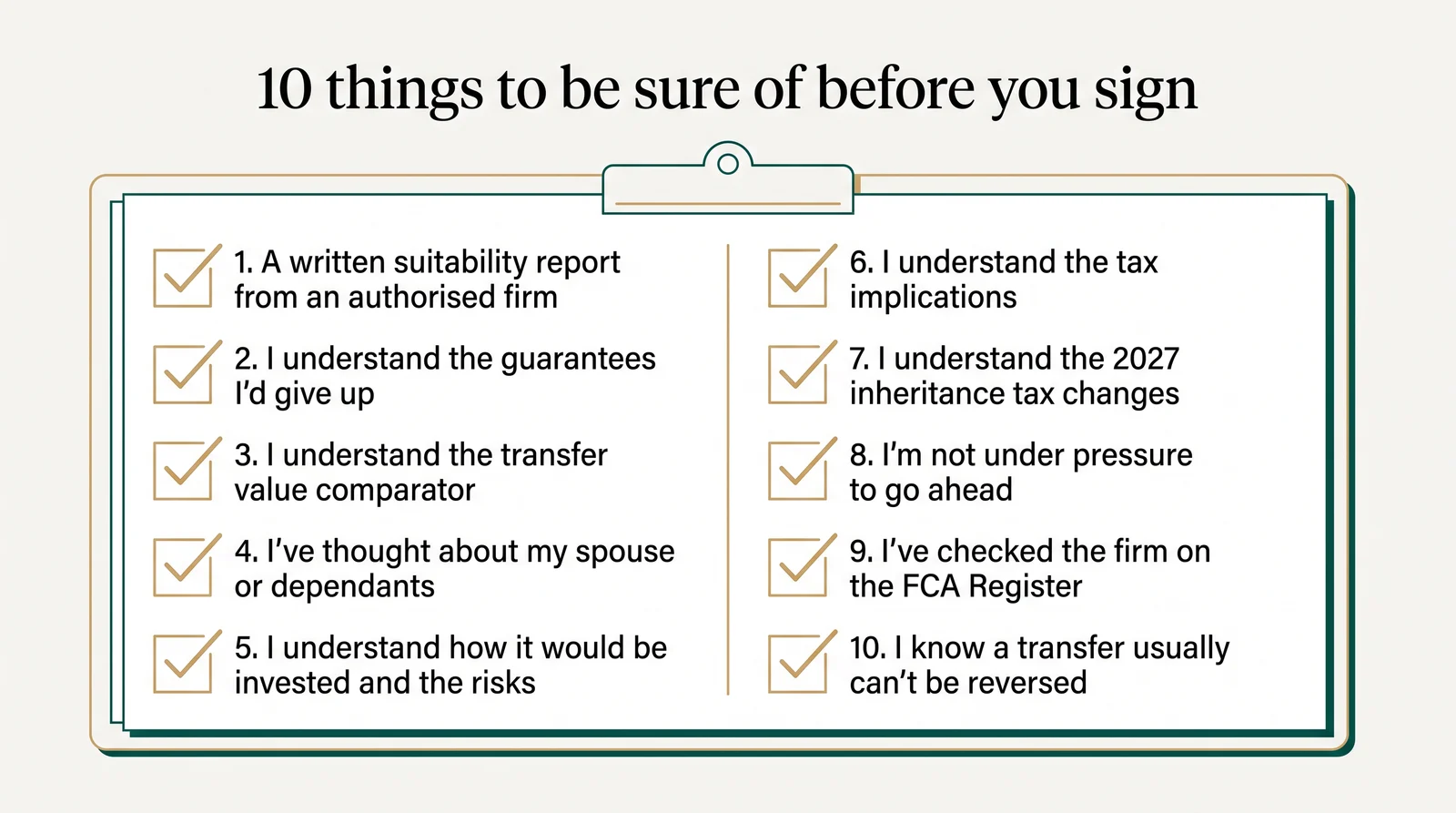
If you have taken regulated advice and are thinking about going ahead, make sure you can say yes to each of these. They are not about whether a transfer suits you, which is the adviser's job. They are about making sure you understand what you are agreeing to. If any are unclear, ask the adviser before going further.
Ten things to be sure of before you sign
- I have received a written suitability report from an FCA-authorised firm with the pension transfer permission
- I understand the guaranteed benefits I would be giving up permanently
- I understand the transfer value comparator and what the analysis shows
- I have thought about the effect on my spouse, partner or dependants
- I understand how the money would be invested and the risks involved
- I understand the tax implications of the transfer and future withdrawals
- I understand how the 2027 inheritance tax changes may affect my plans
- I am not under financial or outside pressure to go ahead
- I have checked the firm on the FCA Register
- I understand the transfer usually cannot be reversed once completed
Getting help
This checklist is designed to help you ask the right questions and gather the right information. It is not a substitute for regulated advice. DB transfers are complex and their consequences are permanent, which is why the law requires regulated advice where safeguarded benefits are worth over £30,000.
A firm with the pension transfer permission will look at your whole financial picture, compare staying in the scheme with transferring, and give you a written recommendation based on your circumstances. The process is thorough for a reason: it exists to protect you. Whatever the outcome, you should come away understanding why.
If you would like a free chat about how DB transfers and the advice process work, you can get in touch. The chat gives general information, not advice. If you then want regulated advice on a transfer value of £50,000 or more, I can introduce you to an FCA-authorised firm that holds the pension transfer permission. Arthur Browns may receive a fee from the firm we introduce you to if you become their client. For smaller pensions, MoneyHelper is a good place to start.
Frequently asked questions
Do I need financial advice before transferring my pension?
If you have safeguarded benefits, such as a defined benefit or final salary pension, worth over £30,000, you are legally required to take regulated advice from an FCA-authorised firm with the pension transfer permission before the scheme will let you transfer. The rule is there to protect people from making an irreversible decision without proper advice.
What documents do I need for a pension transfer?
You will typically need your latest benefit statement, a formal CETV quotation, proof of identity, proof of address, details of your other pensions and savings, and financial information such as your P60 or tax return. The firm advising you will give you a full list.
How long does a pension transfer take?
The advice process can take several weeks, and the transfer itself can take a further few weeks after a decision is made. Some schemes take longer. Your CETV is guaranteed for three months from its guarantee date, so it helps to have your documents ready early.
What are the main red flags for pension scams?
Unsolicited contact, promises of high or guaranteed returns, pressure to decide quickly, unusual investments, firms that are not on the FCA Register, and any offer to release cash from your pension before the minimum pension age. Check the FCA ScamSmart site if you are unsure.
What do I give up when transferring a defined benefit pension?
You give up a guaranteed income for life that does not depend on markets, inflation-linked increases, a guaranteed spouse's or dependant's pension, any GMP or other guarantees attached to the scheme, and the protection of the Pension Protection Fund if your employer fails. Once given up, these cannot be got back.
What is a critical yield?
The critical yield is the investment growth a transferred pot would need each year to match the benefits you would give up. Since 2018, FCA rules have required advisers to use an appropriate pension transfer analysis and a transfer value comparator rather than relying on critical yield, but many advisers still explain it because it helps show how much investment risk a transfer would involve.
How does the 2027 inheritance tax change affect a transfer decision?
From 6 April 2027, unused pension funds and most death benefits are due to come into the scope of inheritance tax. That weakens the argument that a personal pension is a tax-efficient way to pass money on. How it affects you depends on your circumstances and on the final rules, so it is something to discuss with a regulated adviser.
Important: Arthur Browns Wealth Management Ltd (FCA 825843) does not give defined benefit pension transfer advice. The FCA starts from the position that a transfer is unlikely to be suitable for most people, and a transfer cannot usually be reversed. See Important information.
Related reading

Deferred final salary pensions: what happens when you leave
What a deferred final salary pension is, how it grows until you retire, taking it early or late, tracing a lost one, and the rules if you consider a transfer.
Reviewed 23 October 2026 · 9 min read

Enhanced transfer values (ETVs): what they are and the rules
What an enhanced transfer value is, why employers offer one, the industry code's ban on cash incentives, who pays for advice and questions to ask.
Reviewed 23 October 2026 · 9 min read

How long does a DB pension transfer take?
How long a defined benefit pension transfer takes: the 3-month CETV deadlines, the advice stages, scam checks under the 2021 rules and the 6-month limit.
Reviewed 23 October 2026 · 9 min read