Guide
Fixed-Term Annuities Explained: How They Compare With Drawdown


A fixed-term annuity uses some or all of a defined contribution (DC) pension pot to buy a contract from an insurer that pays a set income for a fixed number of years and, usually, a guaranteed lump sum at the end. Because the amounts are fixed by the insurer at the start, the income and maturity value don't depend on stock markets, which is why people sometimes describe it as "guaranteed return drawdown". It suits some people and not others, and the rates on offer change with interest rates.
This guide explains how fixed-term annuities work in general terms. It is not advice, and it doesn't quote current rates, because they change frequently. MoneyHelper has free, impartial guidance on annuities and other ways to take your pension.
Key points
- A fixed-term annuity pays a known income for a set term and usually a known maturity value at the end.
- The amounts are set by the insurer at the outset, so there is no stock market risk during the term, but the money is tied up and inflation can reduce its real value.
- You choose the term, how much income you take and what happens if you die.
- At the end of the term, you can usually move into drawdown, buy a lifetime annuity, take the money as cash (taxed as income above any tax-free amount), or buy another fixed-term annuity.
- Rates depend heavily on interest rates and differ between providers.
What is a fixed-term annuity?
A fixed-term annuity is a type of retirement income product bought with money from a DC pension pot. Some people use them to bridge an income gap, for example until their State Pension or a defined benefit (DB) pension starts. Others use them to hold part of their pension in something with a known outcome for a few years.
Unlike drawdown, where your money stays invested, a fixed-term annuity pays an income set by the insurer, regardless of market movements. When you buy one, you choose:
- how long the term will be
- how much income you want, if any
- what happens to the money if you die during the term
Once you have chosen these options, the provider quotes a guaranteed maturity value: the amount you will get back at the end of the term. That figure doesn't change with investment markets. The guarantee depends on the insurer being able to pay, so it is worth checking how the Financial Services Compensation Scheme (FSCS) protects annuities from UK-authorised insurers.
Only a limited number of providers offer fixed-term annuities, and their rates differ. Comparing the market matters.
At the end of the term, you can usually buy another fixed-term annuity, buy a lifetime annuity, move the money into drawdown or take it as cash. Some people value the certainty of a known income and a known maturity value. Others prefer to keep their money invested.
What options do fixed-term annuities offer?
Fixed-term annuities let you shape the plan around your needs. There are four main choices:
- Term length: you choose how long the plan lasts. Providers offer different ranges of terms, from a few years to much longer.
- Income: you choose how much income to take. The more income you take during the term, the lower the guaranteed maturity value. If you don't need income, some providers let you take none, and the maturity value will be higher.
- Death benefits: you can choose options so that, if you die during the term, the remaining value is paid to your beneficiaries or an income continues for a spouse or partner.
- Guaranteed maturity value: this follows from your choices. The term, income and death benefits you choose all affect the maturity value the provider offers.
Understanding these choices helps you, or your adviser, shape a plan that fits your needs.
Fixed-term annuities compared with drawdown
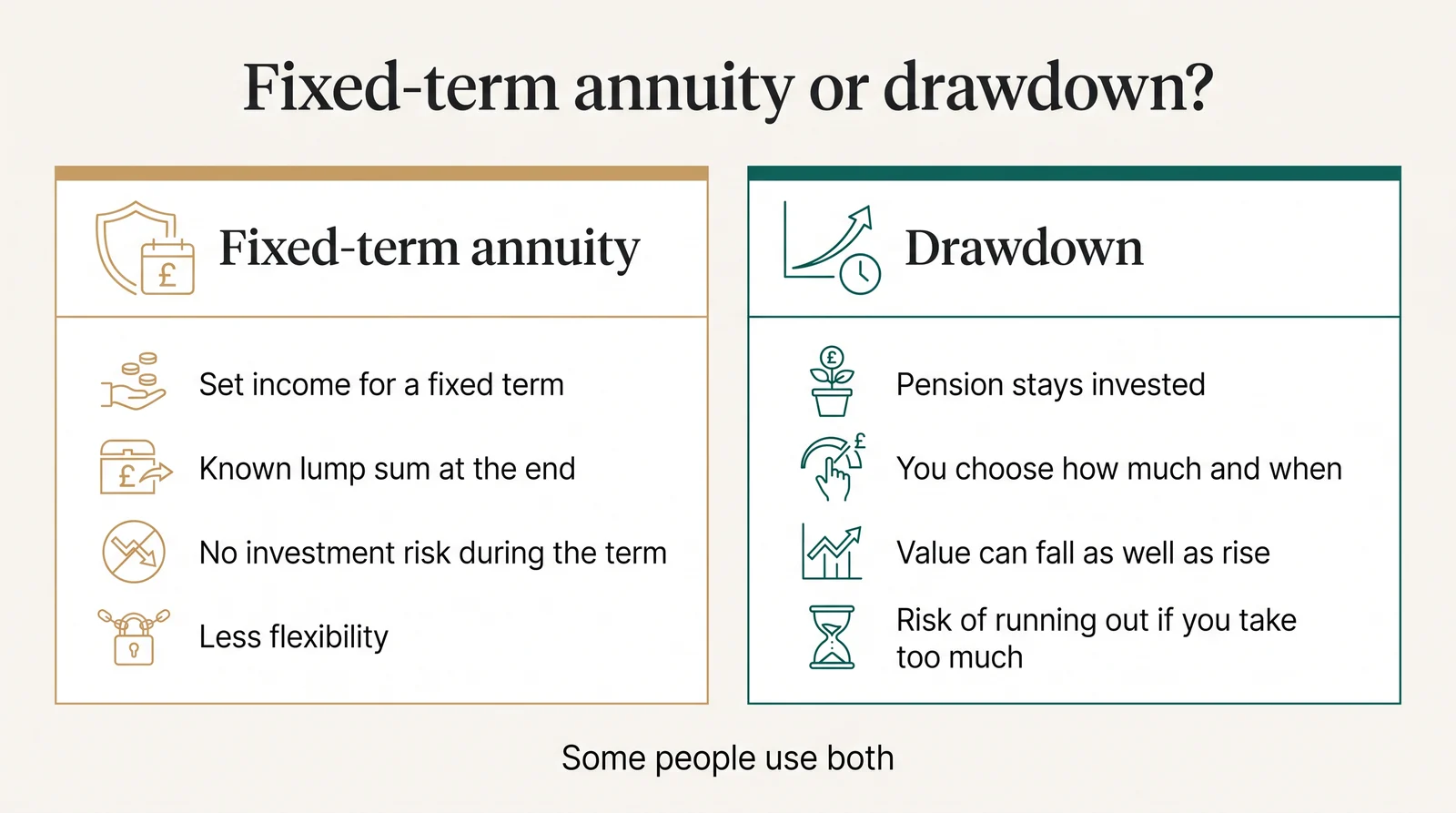
When interest rates were very low, fixed-term annuities offered little and were rarely used. Since interest rates rose from 2022, they have attracted more interest. Which option suits you depends on your circumstances and attitude to risk.
Fixed-term annuities pay a set income for a fixed term, with a known lump sum at the end. You know in advance what you will get, and you can choose death benefits so your money isn't lost if you die early. The trade-off is that your money is tied up, and you won't benefit if markets do well.
Drawdown lets you take income from your pension while it stays invested. It gives you more control over when and how much you take, but the value can go down as well as up, and taking too much too soon risks running short later. Unused funds can be passed on, subject to the tax rules at the time.
If you value certainty for part of your retirement, a fixed-term annuity may be worth looking at. If you can accept your pension falling in value and want the potential for growth, drawdown may suit you better. Neither is right for everyone.
Charges
A fixed-term annuity doesn't usually have a separate annual fund management charge, because your money isn't invested in funds that you choose. The provider's costs are built into the rate it offers. If you take advice, there will usually be an adviser charge. Drawdown usually has product or platform charges and fund charges, plus any ongoing adviser charge. When comparing, look at the overall outcome rather than charges alone.
You don't have to choose one or the other. Some people use a fixed-term annuity for part of their pension and keep the rest in drawdown.
When deciding, think about inflation, when you need the money, how much certainty you want and how much control you want over your retirement income.
What happens if I die during a fixed-term annuity?
If you die during the term, what happens depends on the death benefit options you chose when you set it up. Lifetime annuities without protection stop when you die, but fixed-term annuities commonly offer options such as:
- Value protection: a lump sum is paid to your beneficiaries
- A spouse's or partner's income: income continues to your spouse or partner
- A guarantee period: income continues for a set period
Death benefits from pensions can be taxed, depending on your age at death and how the benefits are paid. From 6 April 2027, unused pension funds and most death benefits are due to come into the scope of inheritance tax, so check how the rules will apply. See our 2027 pension IHT guide and the latest guidance on gov.uk.
How do interest rates affect fixed-term annuity rates?
Fixed-term annuity rates are closely linked to interest rates and gilt yields. When rates rise, insurers can usually offer better terms; when rates fall, the terms on offer tend to fall too.
That means the rates available when this article was first written in 2023 are not a guide to what is available today. Always get up-to-date quotes, and compare them across providers.
Locking into a rate for several years gives you certainty. If interest rates later fall, a rate fixed earlier may look good in hindsight; if rates rise, you may wish you had waited. Nobody can reliably predict interest rates, so it is usually better to focus on whether the product fits your needs than to try to time the market.
Benefits and considerations at a glance
| Benefits | Considerations |
|---|---|
| Known income and maturity value | Money tied up for the term |
| No stock market risk during the term | No share in market growth |
| Death benefit options to protect your money | Inflation can reduce the real value |
| Choice of what to do at the end of the term | Early surrender may cost you, if allowed at all |
Advantages of fixed-term annuities
Some of the advantages people find useful are:
- A known income and maturity value from the outset
- Choice at the end of the term: move into drawdown, buy another fixed-term annuity, buy a lifetime annuity or take cash
- A choice of term, so you can match the plan to when you need the money
- Death benefit options that can protect the value for your beneficiaries
Disadvantages of fixed-term annuities
Fixed-term annuities can limit your access to your money and your ability to respond to changing circumstances.
Once you have committed to a term, you usually can't easily change the plan or take your money out early. Some providers allow surrender, but there may be a cost. This can be a problem if you suddenly need a large sum or your circumstances change.
They also give no share in stock market growth. The income and return are fixed at the start, so you won't benefit if interest rates rise or markets do well during the term. Inflation can also reduce the real value of a fixed income and maturity value.
It is important to weigh these limitations before choosing a fixed-term annuity as part of your retirement plans.
Fixed-term annuities and defined benefit pensions
A fixed-term annuity is bought with money from a DC pension. If your retirement income comes mainly from a DB (final salary) pension, you already have a guaranteed income for life, usually with inflation increases, and it is generally protected by the Pension Protection Fund.
Some people with both DB and DC pensions use DC savings, sometimes through a fixed-term annuity, to bridge the years before their DB pension starts. That is very different from transferring the DB pension itself. A DB transfer gives up guarantees that can't be replaced, the FCA's starting assumption is that a transfer is unlikely to be suitable for most people, and the law requires regulated advice if the benefits are worth more than £30,000.
If you have an older personal pension with a guaranteed annuity rate (GAR), check it before buying any other annuity or moving the pension, as moving it usually means losing the GAR. I can advise directly on pensions with guaranteed annuity rates, subject to suitability; advice is chargeable.
Frequently asked questions
What is the difference between a fixed-term annuity and drawdown?
A fixed-term annuity pays a known income and maturity value for a set term, with no stock market risk during the term. Drawdown keeps your pension invested and lets you vary your income, but the value can fall as well as rise. Which suits you depends on your attitude to risk, need for certainty and retirement income goals.
Can I change my options during the term of a fixed-term annuity?
Usually not. The options you choose at the outset are normally fixed for the term, because the guaranteed maturity value is based on them.
Are there penalties for taking money out of a fixed-term annuity early?
Some providers allow you to surrender the plan early, but you may get back less than you expect. Others don't allow it at all. Check the terms and conditions before you buy.
Can I buy a fixed-term annuity with money from my pension pot?
Yes. Fixed-term annuities are bought with money from a DC pension pot, from the normal minimum pension age, which is 55 now and due to rise to 57 on 6 April 2028 unless you have a protected pension age. Many people take tax-free cash first and use the rest to buy the annuity.
Who are fixed-term annuities suitable for?
They are not suitable for everyone. They may appeal to people who want certainty for part of their pension for a set period, or who want to bridge an income gap. They may not suit people who need easy access to their money or who want the potential for growth. Free guidance from Pension Wise can help you understand your options, and a regulated adviser can give advice.
What happens to my fixed-term annuity if I die during the term?
It depends on the death benefit options you chose. Common options include value protection, which pays a lump sum to your beneficiaries, a spouse's or partner's income, or a guarantee period. Tax may apply, and from 6 April 2027 unused pension funds and most death benefits are due to come into the scope of inheritance tax.
Can I take an income from a fixed-term annuity?
Yes. You can usually choose whether to take a regular income during the term or take little or none. The more income you take, the lower the guaranteed maturity value at the end.
How do I find the best fixed-term annuity rate?
Only a limited number of providers offer fixed-term annuities, so compare quotes across the market. A regulated financial adviser can carry out a market comparison for you. Rates vary between providers and change with interest rates.
Are fixed-term annuities protected if the provider fails?
Annuities from UK-authorised insurers are generally protected by the FSCS. Check the FSCS website for current details.
Summary
A fixed-term annuity may be worth considering if you want a known income and a known maturity value for part of your pension over a set period. It offers a choice of terms, options at the end of the term and death benefits that can protect your money.
It also ties your money up, gives no share in market growth and can lose real value to inflation. Weigh up the advantages and disadvantages carefully, compare providers, and consider free guidance from MoneyHelper or regulated advice before deciding.
Be wary of anyone who contacts you unexpectedly offering "guaranteed" returns on your pension. The FCA's ScamSmart site explains how to spot pension scams.
Important: Arthur Browns Wealth Management Ltd (FCA 825843) does not give defined benefit pension transfer advice. The FCA starts from the position that a transfer is unlikely to be suitable for most people, and a transfer cannot usually be reversed. See Important information.
Related reading

Beware of Pension Scams: Protecting Your Retirement Savings in the UK
How pension scams work, the warning signs to look for, the checks to make before any transfer and where to report a suspected scam in the UK.
Reviewed 22 October 2026 · 9 min read

Pension Consolidation in the UK: Unlocking Simplicity and Control
What pension consolidation means in the UK, its benefits and risks, and why DB pensions and pensions with GARs or GMPs need extra care before any move.
Reviewed 22 October 2026 · 7 min read
 Illustrative example
Case Study: DB Pension Transfer Decision for a Former Construction Manager (2026)
Illustrative example: a former construction project manager, 57, with a £258,000 CETV. What a regulated adviser might weigh, and why keeping is likely.
Reviewed 22 October 2026 · 6 min read